All posts by Richard Ha

Electric Car

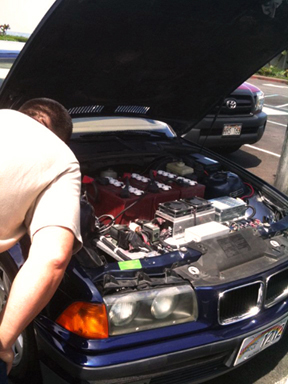
A real, live, homemade electric car.

License plate

Barry Mizuno’s customized license plate

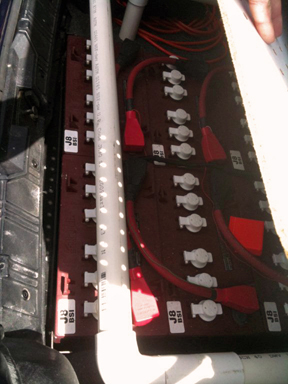
Barry Mizuno ordered this electric car from a person who does electric car conversions on the mainland. He removed the motor from this BMW and installed the batteries and electric motor.

Barry tells me that he just parks his car in his garage, and plugs it in from where the gas cap used to be.

Electric car
Mike Kaleikini, Manager of Puna Geothermal, asks, “What happened to the motor?”

Batteries
More batteries in the trunk!

What strikes me is realizing that my friends who took auto mechanics in the 1960s could do these conversions. When the large auto makers went to electronics and computer run cars, they left a lot of the regular folks behind. This will allow folks to wrench their own cars again. I have the feeling some will start to convert cars in Hilo soon.

I’m jealous. I think I’ll have my sampan bus converted to electricity.

Peter Merriman and Sampan bus 002
Here are Peter Merriman and his guys standing next to our sampan bus

Last summer, when oil prices were at $147, my nephew told me: “Uncle, I’m thinking of selling my truck and getting a scooter to go to work.” Right then, I knew that the world had changed.

Guys like him now have the option of converting a car to electric, rather than buying a scooter.

I’ll bet that an electric Volkswagen would give him just as grand a self-image as a big-tired 4 x 4 with a pitbull in the back.

Visiting the Corn

We are preparing for a future of decreasing world oil supplies by transitioning from being the only producer on 600 acres of land at Pepe‘ekeo to being a model of multiple family farms.
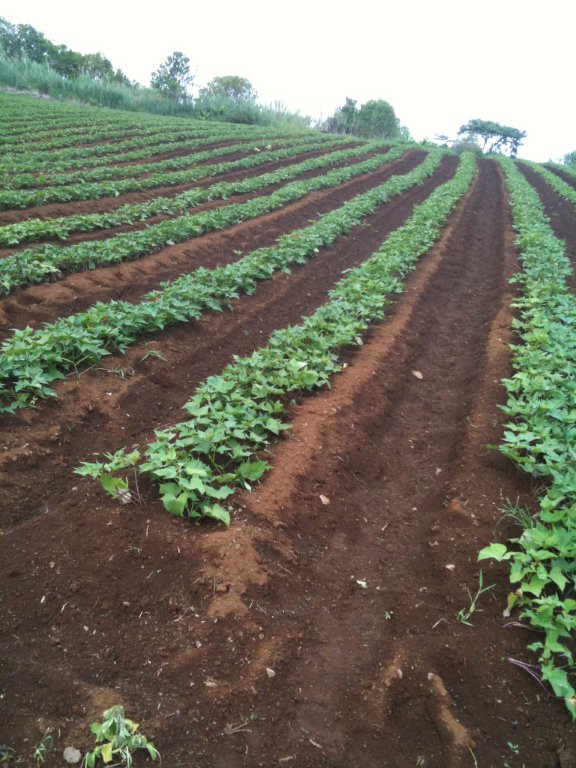
Sweet potato, to be followed by sweet cornSweet potato, to be followed in rotation by sweet corn

And it’s growing. We now have one of the best sweet potato and ginger growers on the Big Island planting on our land. Following Tai Wan Gu in rotation is Daniel Loeffler, the Big Island’s premier corn grower. We are looking for one more crop to fit into the rotation; maybe some kind of grain to make pelletized animal or fish food.

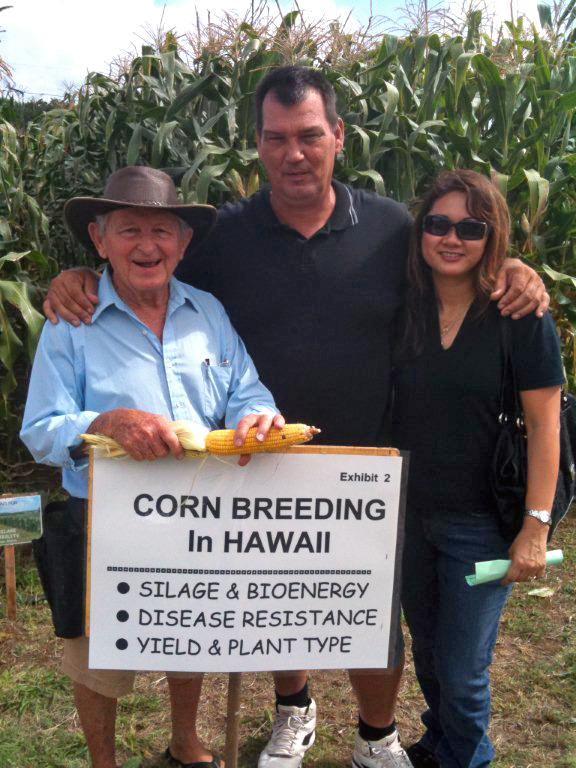
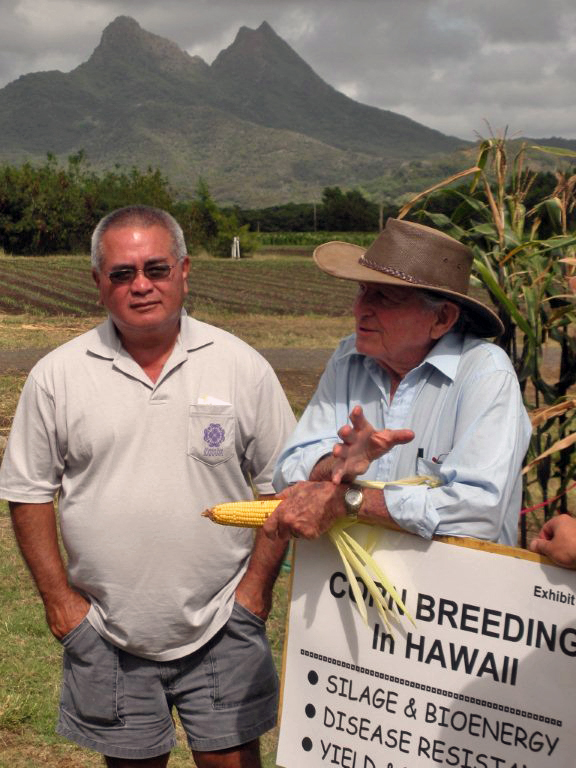
James B, Daniel & Jennifer LoefflerJames Brewbaker (left), Daniel and Jennifer Loeffler

Last Wednesday, Daniel told me that there was going to be a field day at the Waimanalo Research Station on Saturday. He told me that the famous corn breeder, Dr. James Brewbaker, would give a talk and that there would be a tasting of new corn varieties. So June and I decided to take a break and go to the field day.

Richard & Dr. BRichard (left) and Dr. B. (Photo by another well-known Brewbaker, Richard’s friend Paul Brewbaker, long-time lead economist for the Bank of Hawai‘i and Dr. B.’s son.)

Dr. B. talked about how he bred the Hawaiian sweet corn for many traits. In addition to sweetness, his primary objective was to avoid the use of pesticides. This is a big deal, because it is possible to grow the corn Dr. B. breeds and not have to spray for fungus diseases or for insects. Grass control still needs to be done using a combination of spraying and tilling.

Just imagine not having to spray to control diseases. Dr. B bred the corn so it has tight wrapper leaves. The objective was to make it difficult for the corn ear worm to work its way down the corn ear, because the wrapper leaves prevents this. Again, one would not have to spray for the corn ear worm if one could tolerate the worm just living in the tip of the corn. Most people can live with this. One worm is not a big deal, but avoiding the spraying of pesticides is.

We were told that we could walk into the demonstration plots and harvest corn. Daniel got a few ears to sample. He peeled off the wrapper leaves and offered the raw corn to several of us. It was incredibly sweet. Actually, the best way to eat Hawaiian sweet corn is raw.

We moved over to where the corn tasting was going on and were asked to rate two different varieties. We all agreed that selection B was head and shoulders better than selection A. We did not find out what the name of selection B was. But that is the one to grow. No doubt.

The traffic on O‘ahu on a Saturday was surprisingly dense. It was nice to fly back to slow-moving Hilo.

Comment on Hawaii Bioenergy Master Plan

The State’s bioenergy master plan was released for comment last week, and final comments are being accepted until October 2nd.

Why the rush?

Before it is released, the plan is already obsolete for the Big Island. Biofuels will not result in lower costs for ratepayers.

Here on the Big Island, though, we have an option that will – geothermal.

From the master plan:

“The primary objective of the bioenergy master plan shall [be to] develop a Hawaii renewable biofuels program to manage the State’s transition to energy self-sufficiency based in part on biofuels for power generation and transportation.”

Geothermal has a better chance of achieving the above objectives of self-sufficiency in power generation as well as transportation.  It does not utilize any fossil fuels in its production, does not produce any greenhouse gases to speak of and does not compete with food production. It is proven. It can even help HELCO manage the grid.

Furthermore, it is a resource benefiting native Hawaiians – through royalties and possibly rents.

Biofuels have a very poor Energy Return on Energy Invested (EROI), below 2 to 1. This is below the minimum EROI a sustainable society requires, which is considered to be 3 to 1.

By contrast, geothermal has an EROI of approximately 10 to 1, and that is not expected to change in the next few centuries.

We owe it to future generations to do the right thing.

Read the plan (see the link above) and submit comments by emailing them here no later than October 2, 2009.

Here is the comment I submitted:

Aloha:

I am Richard Ha. We farm 600 fee simple acres of various fruits and vegetables in Pepe‘ekeo. In addition, I am treasurer of the Hawaii Farm Bureau Federation.

I have several comments regarding this master plan.

If oil is $200 per barrel, one pound of that oil is worth 70 cents. Farmers estimate that it might take four pounds of stuff to make one pound of liquid. As a rough estimate, farmers know that the most they can get for the stuff they grow when the price of oil is real high is approximately 18 cents per pound. At today’s oil price, they would only get 6 cents per pound. Better to grow cucumber.

It does not matter what the stuff is.  The costs, to maintain, harvest, pre-process and transport the stuff, are related to oil prices. So as oil price rise, the cost of growing the stuff also rises. It is kind of like chasing the mechanical rabbit at the greyhound racetrack. The dogs never can catch the rabbit. So small farmers will not likely become a major supplier of biofuels.

Because of the commodity characteristics of biofuel, the producers are likely to be larger industrial type agriculture participants. There are only a few places that lend itself to that kind of farming. It is reasonable to assume that food and fuel will be competing for the same land. There should be an analysis done to evaluate this.

There should be an Energy Return on Investment (EROI) analysis of the various types of biofuels so it can be compared against other energy alternatives. It is estimated that the EROI for oil was 100 to 1 in the 1930s – i.e., it took one barrel of oil to get a hundred. This declined to 30 to 1 in the 1970s, and recently it has been hovering around 10-15 to 1. But as it becomes more and more difficult to get oil, that ratio is steadily declining.

It has been estimated that an EROI ratio of 3 to 1 is the minimum necessary to maintain a sustainable society. http://www.mdpi.com/1996-1073/2/1/25/pdf.
Biofuels are estimated to be less than 2 to 1.

This study should not exist in a vacuum. We know that electric vehicles are around the corner.  What is the advantage of pursuing a product that has an EROI of 2 to 1, versus one like geothermal that has an EROI of approximately 10 to 1 that will not decline for the foreseeable future?

It is my opinion that pursuing biofuels is the wrong solution to our energy problem.

Richard Ha
President,
Hamakua Springs Country Farms

Crisis re: Plant Quarantine Inspectors, and a Solution

The Hawai‘i Department of Agriculture will keep 22 of the 50 Plant Quarantine Inspector positions it proposed eliminating during its August “Reduction in Force” announcement.

From the Department of Agriculture press release:

The rescission of the 22 notices will allow the department to further support core inspection services at all ports statewide; however, inspection capacity will still be significantly decreased from current levels.

It is unacceptable to simply let food crops into Hawai‘i without being inspected, using the excuse that we cannot afford the inspection.

“The department continues to look for alternative sources of funding,” said Sandra Lee Kunimoto, Chairperson of the Hawai`i Board of Agriculture.  “In addition, we are working on increasing coordination of inspection services to make the most efficient use of our work force and minimize the disruption to our important agricultural, food and shipping industries.”
We should charge importing companies the cost of inspection. It is definitely not fair to expect farmers to pay for the inspection of foreign-grown produce, by way of taxation.

Sustaining a Population

What is the Minimum EROI [Energy Return on Investment] that a Sustainable Society Must Have?

by Charles A. S. Hall, Stephen Balogh and David J. R. Murphy
Program in Environmental Science, State University of New York – College of Environmental Science and Forestry, Syracuse NY, 13210, USA

…Every plant and every animal must conform to this iron “law” of evolutionary energetics: if you are to survive you must produce or capture more energy than you use to obtain it, if you are to reproduce you must have a large surplus beyond metabolic needs, and if your species are to prosper over evolutionary time you must have a very large surplus for the average individual to compensate for the large losses that occur to the majority of the population. In other words every surviving individual and species needs to do things that gain more energy than they cost, and those species that are successful in an evolutionary sense are those that generate a great deal of surplus energy that allows them to become abundant and to spread. While we are unaware of any official pronouncement of this idea as a law, it seems to us to be so self-obvious that we might as well call it a law – the law of minimum EROI – unless anyone can think of any objections.Read the rest of the article here

A mother cheetah must chase and catch a gazelle or rabbit and obtain enough energy from it not only to feed her kids, but also to be able to chase another one down and even survive some days without catching anything.

Hawaiians understood this concept very clearly. It’s why in the Hawaiian culture there is such a close affinity to the land, the ocean and all things in nature: That is where the surplus energy came from to sustain the population.

The move to populate Hawai‘i probably came from a need to find surplus energy (food) caused by overpopulation or similar in the navigating Polynesians’ home islands.

We all know there are clouds on the horizon now, and that our surplus energy supplies are again threatened.

In the 1930s, it took one barrel of oil to obtain 100 barrels. In the 70s, that ratio had decreased to 1 to 30. A few years ago, it was estimated to be 1 to a little more than 10.

When it finally dawns on all of us that our oil supplies will never increase, people will get frightened. But at that point, it will be too late.

Most of us Hawaiians look upon our geothermal resource as a gift. And even more so now, when it can be a matter of survival of the species.

We’ve done it before and we need to do it again. Pau talk, ‘nough planning. We go!

Envy Of The World

Here is an easy-to-understand video that explains Peak Oil, and it’s well worth watching.

It isn’t a theory of when oil will run out. Rather, it’s a description of what happens to oil wells as they age, and it makes simple collective observations and assumptions about all the oil wells in the world. It is simple and easy to predict that oil will become more and more costly.

When that happens, we will need to get out of the line of fire. It’s not complicated.

We are incredibly lucky here on the Big Island, because we have a geothermal resource beneath us at many locations all around the island. The State owns this resource. They should go map it out and contract out the energy production to the highest bidder. Part of the rents and royalties would go to the Native Hawaiian people, on whose land it sits, and the actual energy would benefit all of us.

Geothermal energy can also be used to make hydrogen. In the future we will run our cars and trucks on hydrogen, using the internal combustion engine. Here’s a clip of a hydrogen car that was shown on Good Morning America.

The electric utilities are using internal combustion engines — just larger  than most. Could we run it all on hydrogen? If hydrogen can be used in regular car engines, could it be used in the diesel engines that the electric utilities use to generate electricity?

Can you imagine it? The biggest and the best telescope in the world located on the Big Island. And most of the state’s electricity needs powered by geothermal wells on the Big Island. Rents and royalties would go to Native Hawaiian people and the rest of us would have the benefit of being free of Middle East oil.

We would be the envy of the world.

Not, no can. CAN!

Hawaii In The Time Of Peak Oil

In June of last year, Gail Tverberg wrote this post at The Oil Drum Blog, and just a few days ago she reposted it:

Hawaii seems to come up often in the thinking of people aware of peak oil. On one hand, it seems like an ideal place to relocate after peak oil – no need to worry about heating a house; clothing is mostly for protection from the sun; and crops can be grown year around. On the other hand, it produces no fossil fuel itself, and it is at the end of the supply line for both food and fuel. Hawaii’s biggest industry, tourism, is already declining, and with rising fuel costs, can only decline further.

When the Kohala Center started planning its energy conference a while back, I recommended they invite Gail to be the featured speaker. I had met her at the Peak Oil conference in Houston and was very familiar with her writing on The Oil Drum. As an insurance actuary, she assesses risk for the insurance industry. I like what she writes because it is clear and easy to understand.

She gave two talks in Hilo. The first was at the energy conference itself and the second, a free presentation to the Kanaka Council that I arranged.

I took her sightseeing around the Big Island over that weekend, so I got to chat with her quite a bit about oil supply matters.

Here is a very interesting post she did at the Energy Bulletin in March 2009. She wrote:

Nearly all of the economic analyses we see today have as their basic premise a view that the current financial crisis is a temporary aberration. We will have a V or U shaped recovery, especially if enough stimulus is applied, and the economy will soon be back to Business as Usual.

I believe this assumption is basically incorrect. The current financial crisis is a direct result of peak oil. There may be oscillations in the economic situation, but generally, we can’t expect things to get much better. In fact, there is a very distinct possibility that things may get very much worse in the next few years.

Whether or not one believes Gail is right — that the current financial crisis is caused by Peak Oil — it is prudent that we plan for the worse and hope for the best. I think our most reasonable path is to actively pursue geothermal energy. We must help HELCO figure out how to decommission their oil-fired plants — put them in moth balls, in standby mode, and replace them with geothermal plants, preferably ones that are geographically diversified. At the same time, we need to figure out how to leave their stockholders whole. We can do this.

The reason we need geothermal is that geothermal energy costs are stable. With geothermal, our electricity and water bills would not go up as oil prices rise. And our transportation costs could stabilize, as well. We could have a successful economy here in Hawai‘i in spite of rising oil prices.

If we don’t go geothermal, rising foreign oil costs could bankrupt us. Our society could come apart.

Switching to geothermal is not an option; it is a necessity. We all know this.

What We Are For

Something interesting is starting to happen.

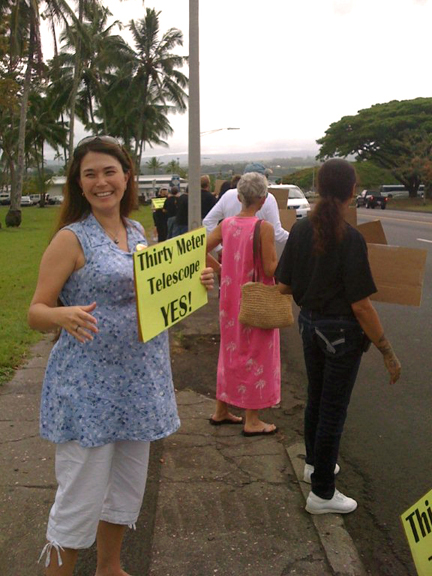
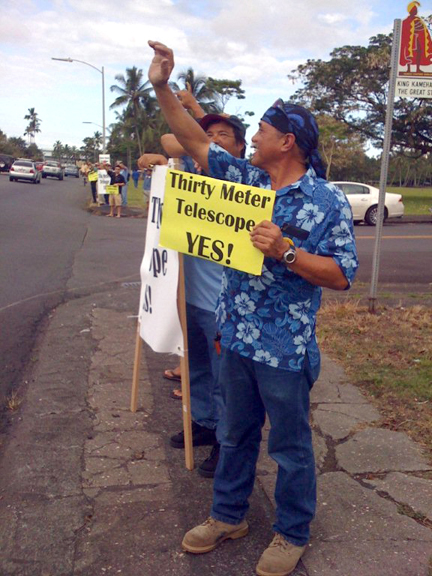
The Governor has been giving speeches using what happened here on the Big Island – residents turning out to support the Thirty Meter Telescope – as an example.

In a recent speech, Governor Lingle said:

“In our time it seems to be that people are real quick to tell you what they’re against and what they don’t want, but they don’t seem to be able to articulate a clear vision for what we do want. What are we for? And then put at least as much effort behind what we’re for as behind what we’re against.”

Lee Cataluna wrote yesterday, in her Honolulu Advertiser column, about that recent Lingle speech:

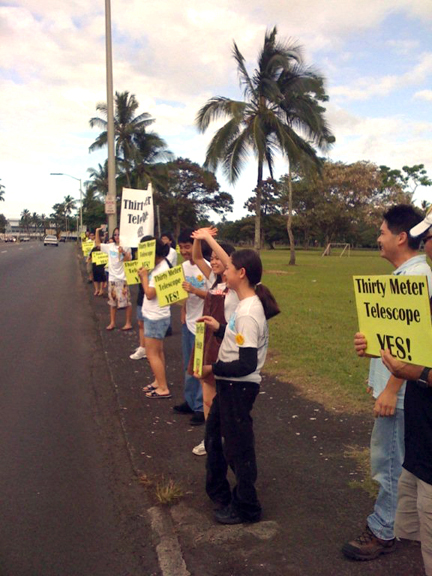
[Lingle] used the example of Hilo residents demonstrating in support of a new Thirty Meter Telescope. They held signs for what they wanted. “Picture this: The community coming out on the street, not for something they were against, but something they were for … They got the telescope. They’re building that bright future for the kids there on the Big Island.

We thought we’d rerun our post from June 15, 2009, to show what she’s talking about:

***

It was a coalition of folks from all sectors of the population that came to wave signs the other day.

Signs1
It’s about the keiki. Kumiko S. Usuda, Outreach Scientist (Astronomer) at the Subaru Telescope, and her children.

June & Dina
June Ha and Dina

Signs3
It’s not about us. It’s about future generations. This is Suzy Dill and her future generation.

Signs4
Pete Lindsey and the boys

Signs5
Waiakea High School Robotics club

Signs6
UH Hilo Astronomy/Physics Professor Marianne Takamiya and family

Signs7
left, Barbara Hastings, Outgoing President of the Hawaii Island Chamber of Commerce; center, Incoming President Mary Begier

It is not about us anymore. Now it is about the keiki and future
generations. It was very gratifying to see high school students, young kids, a hapai mom – the next generations.

The Labor Union and business folks were there, too. Jobs are about families and the here and now.

The Big Island Labor Alliance played an important role. The labor folks tell me that there are by far more Hawaiian workers on the bench now than all the people who testified on both sides of the issue at the Comprehensive Management Plan hearing recently. They wonder why their voices are not heard.

There were educators there, too, who think about the value of new learning.

It was uplifting to hear all the people blowing their horns in support. It was louder this time than last. All kinds of different sounds — especially raucous were the big rigs and their air horns!

Act 175, New Procurement Law

The Honolulu Advertiser ran an article – Hawaii law may hurt farmers; Bid process could bring more outside competition – last week. It talks about Act 175, the new law that requires state agencies to gather competitive bids before buying food and other agricultural products.

Although there was a preference for local agricultural products in the previous law, the Hawaii Administrative Rules exempted local products from the law that required open competition, transparency of government purchasing practices, and additional preferences such as small business ones.

The state could have chosen to give preference to local produce with this new law; they just chose not to.

From the Advertiser article:

While the intent of the law is to support local growers, not all officials are convinced that will be the effect….Competitive procurement is expected to draw more Mainland competition, even with the 15 percent advantage given to local growers.

Farmers are incredulous. Prior to enactment of Act 175, state agencies purchased very little from local farmers. What’s to lose?

“If … it becomes a competitive process, we’re not sure exactly what the effect would be – whether it would be positive or negative, because nobody has any experience with that,” said state Agriculture Director Sandra Lee Kunimoto. “But the farm bureau and the farmers felt it was worth trying to see if it would increase the purchase of local goods.”

State Procurement Office Administrator Aaron Fujioka agreed. “It didn’t have to be competed, and it could be all purchased local from local companies locally grown,” Fujioka said. “The prior exemptions allowed agencies, if they chose, to purchase only from local companies and locally grown fresh produce and meats. They could have done that. Now that choice is no longer available. It has to go through a formal, more structured process.”

State agencies could have chosen to buy local produce, but they all chose not to. Out of 650 Big Island Farm Bureau members, I know of only one who sells to state agencies – and she has to go through a third party. Hawai‘i farmers know it is impossible to get produce into the schools and other state agencies.

We farmers welcome a formal, more structured process. But this time we want to help structure that process.

According to the state Procurement Office, state agencies purchased $6.63 million of fresh meat and produce from November 2005 through January 2009. The average award was about $7,400. The top three suppliers during that period in terms of dollar volume of sales were Love’s Bakery ($907,813), Meadow Gold Dairies ($511,295) and Mikilua Poultry Farm ($500,000). The top three suppliers in terms of number of awards were: Ham Produce (162), Hilo Products (133) and Armstrong Local Produce (132).

Procurement Office data suggest that most fresh food and produce purchased by state agencies came from local wholesalers and retailers. What isn’t clear is whether those local firms acquired their produce from local farms.

That is exactly the problem. It’s as if the state procurement office is saying: “Since we are buying from a local wholesaler, it must be local produce.” Farmers just shake their heads and go back to farming.

Farmers have known for years that the system is broken. There is no data to show how much of the state procurement is locally grown foods. How would the state know if their policy of “supporting local” is working?

The state says, “We support local farmers.” Farmers think, “It’s not what you say; it’s what you do.”

Farmers shake their heads. We know that the more fresh vegetables we import, the more inspectors we need and the higher the risk of invasive species.  We have more endangered species here in Hawai‘i than in the whole rest of the United States.

“The Big Island farm bureau polled their members, and they’ve got 650 members – and they only had one producer selling on a regular basis to the state and one who shipped their first shipment this year,” Connally said. “Their sense was their products were not going into the state facilities.

“If the farmers see that there’s a steady market available, then they can produce for that market.”

It’s what I keep saying: “If the farmers make money, the farmers will farm.”

Food security; the dangers of exporting our economy because of rising oil prices; protecting our endangered species – when we are truly supporting local farmers, we are addressing all of these concerns.

The world has changed and we no longer have the luxury of bumbling along. For the sake of future generations, we need to get serious.

Farmers understand this very clearly. This is not rocket science.

Farmers who are interested in helping push implementation forward can contact their legislators, the governor’s office and the state procurement office.

It may not be in the farmer’s nature to be vocal, but we need to make some noise.

Extra! Extra!

A letter of understanding was published yesterday. It was signed by most of the world’s major auto makers — Daimler, Ford, GM/Opel, Honda, Hyundai/KIA, the Alliance Renault/Nissan, Toyota — and encourages governments to develop a uniform hydrogen transportation infrastructure by 2015.

From the letter:

…In order to ensure a successful market introduction of fuel cell vehicles, this market introduction has to be aligned with the build-up of the necessary hydrogen infrastructure. Therefore a hydrogen infrastructure network with sufficient density is required by 2015. The network should be built-up from metropolitan areas via corridors into area-wide coverage….

Let’s get on board!

Most people know that hydrogen is feasible using renewable, stranded power. It does not work when the power comes from fossil fuels.

Geothermal works! It can power up electricity as well as support a hydrogen transportation system.