All posts by Richard Ha

Taking Responsibility: Creating a Mauna Kea CMP

I’ve been thinking a lot lately about a Letter to the Editor I recently read in the Hawai‘i Tribune Herald. It said that the contentious and boisterous protest at the Comprehensive Management Plan (CMP) hearing held in Keaukaha could be seen to imply that all Hawaiians think alike.

The letter’s author asserted, though, that Hawaiians are as diverse in their opinions as any other segment of the population. And he wanted to make the point that he, specifically, did not agree with all the protestors.

This person took responsibility for his own opinion.

It made me wonder what my responsibility is now, since I volunteered three years ago for the newly formed Thirty-Meter Telescope (TMT) committee of the Hawai‘i Island Economic Development Board (HIEDB). I volunteered because I felt strongly that if this large telescope is to be built on Mauna Kea, it must be done right.

Subsequently, I have learned a lot about previous history and present circumstances regarding the mountain. Having gained such an education on the subject, I ask myself:

What is my responsibility to share what I know?

I have learned that there are still lingering and strong feelings of anger and resentment toward the University of Hawai‘i at Manoa. People were very, very angry that prior to 2000, Mauna Kea was being controlled from O‘ahu rather than by people here on the Big Island.

I know I was very angry myself in the past. My own lingering anger was a large part of my reason to volunteer for the HIEDB’s TMT committee.

There were many selfless community volunteers back then, who took a lot of criticism as they tried to figure out how to wrest control from O‘ahu. Physical traffic and rules of behavior were subsequently transferred to the University of Hawai‘i at Hilo – but without adequate funding or authority to enforce the rules.

Because of the complexity of these problems, the University of Hawai‘i at Hilo is often saddled with those ill feelings from previous years, perhaps unfairly.

They do not work alone. The Chancellor of UH Hilo gets advice from the Mauna Kea Management Board, which is made up of very dedicated members of the public who make policy suggestions for the mountain’s management (with no pay). Kahu Ku Mauna is another board of cultural advisors—they also serve with no pay.

Recently, in a very clear, easy-to-understand ruling, Judge Glenn Hara reversed the Department of Land and Natural Resource’s (DLNR) issuance of a Conservation District Use Permit allowing the building of six “outrigger” telescopes on Mauna Kea.

Basically, the judge stated that the management plan submitted to support the application was too site-specific. It needs to be more comprehensive. So the DLNR needs to approve a Comprehensive Management Plan that takes into account the judge’s concerns. It does not say that the DLNR needs to create the plan itself.

This is why the Comprehensive Management Plan hearings are taking place now.

I attended most of the hearings and heard most of the testimony. In my opinion, the reason so much of the testimony was so emotional was because people did not believe they were being heard.

I know the people in charge of the plan, and I am convinced they are listening very carefully and will include everyone’s concerns. It is clear, though, that they have to weigh the needs of protecting the natural resource as well as the cultural resources.

There are some process questions that some feel are very important.  For example, some feel that the DLNR, not UHH, should actually be creating the CMP. They say that UHH developing the plan it is akin to the fox guarding the henhouse.

The people creating the plan are very credible experts in their field. But no matter who does the plan, the DLNR board will still have to approve it. I don’t think these people are just rubber stampers.

Some say an Environmental Impact Statement should be done alongside the CMP. I think that reasonable people could agree that the CMP is merely a plan, not a specific project. It’s not about building, or any physical project, it’s just a plan—no stones will be moved and no insects will be disturbed. To add an extra measure of care, an Environmental Assessment is being done.

Whenever a new project is proposed, it will trigger its own Environmental Assessment or an Environmental Impact Statement.

But if people feel strongly about these types of process questions they can seek legal recourse. I don’t think a reasonable person would consider these issues so weighty that they should stop the Comprehensive Management Plan from being put in place.

This is all about taking care of Mauna Kea.

So knowing what I know, do I take a stand? Am I not responsible for what I know?

Judge Hara’s intent is for the DLNR to have a management plan in place to take care of Mauna Kea in a holistic way. That is exactly what we all want!

Are there questions so serious that it would be better for us to wait for an answer rather than take care of Mauna Kea now with a Comprehensive Management Plan in place? I don’t think so.

As I think about that Letter to the Editor, where the person took responsibility for his own opinion, I too feel a need to take responsibility for my own.

I say: Let’s get a Comprehensive Management Plan in place now so we can start to malama Mauna Kea.
Secretary of Food

A New York Times op-ed by Nicholas Kristof, published Wednesday, starts like this:

As Barack Obama ponders whom to pick as agriculture secretary, he should reframe the question. What he needs is actually a bold reformer in a position renamed “secretary of food.”

A Department of Agriculture made sense 100 years ago when 35 percent of Americans engaged in farming. But today, fewer than 2 percent are farmers. In contrast, 100 percent of Americans eat.

Renaming the department would signal that Mr. Obama seeks to move away from a bankrupt structure of factory farming that squanders energy, exacerbates climate change and makes Americans unhealthy – all while costing taxpayers billions of dollars.

Here in Hawai‘i, we need to rethink our own structure so we will be able to effectively deal with tomorrow’s problems. Some of our most pressing problems have to do with agriculture and energy. They are inextricably intertwined.

Fossil fuel energy has allowed agriculture to feed the world’s people. In a world of declining fossil fuel energy, we must reorganize so that our agricultural systems maximize our available resources.

This also means that we need to incentive farmers to utilize renewable energy sources. For example, it is not wise these days to subsidize value-added processing plants that depend on fossil fuel energy. When energy prices rise again, as we all know they will, those processing plants will end up as skeletons bleaching in the sun.

We know that to become food secure, farmers need to be able to make a living. It is not rocket science: “If the farmer makes money, the farmer will farm.”

Instead of relying on imported foreign labor to produce our food, we need to think about relocating our farms to where the labor supply is located. This means we need to disburse our food production so that it’s all throughout the state.

Utilizing new, renewable energy sources to generate power can catch the next generations’ imagination and convince them to farm. It’s much more interesting than watching tomato plants grow.

Read the rest of the New York Times article here.

Trouble on Hawai‘i’s Farms

Hawai‘i’s farmers are in trouble. There was an informational meeting of the House Agriculture, Water, Land and Ocean Committees Friday, and several of us testified. A post about it on the House of Representatives blog is titled The Rodney Dangerfield of the Economy and refers to how agriculture “doesn’t get any respect.”

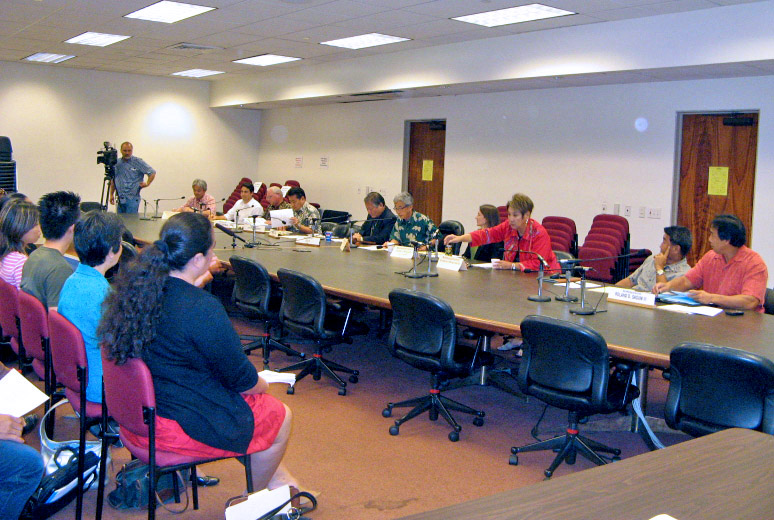
IMG_0155_1House Committees on Agriculture, Land, Water and Ocean. The Farm Bureau requested this informational hearing prior to the regular session.

This informational meeting came about after I gave a short speech at the Farm Bureau convention in October. Everybody’s business was in trouble but nobody wanted to talk. It’s local style to keep quiet, be reticent and not complain. I told the farmers in attendance that I knew they were having a hard time and that they should not have to suffer in silence.

I said, “You shouldn’t feel like you have to make an excuse. In fact, you shouldn’t have to shoulder the whole burden yourself.”

Shortly after that, Mae Nakahata, Vice President of the Farm Bureau, called me and said that some of the farmers she knew were in serious financial trouble. She then started the ball rolling to do something to help farmers. She was the driving force behind Friday’s informational meeting of the legislators.

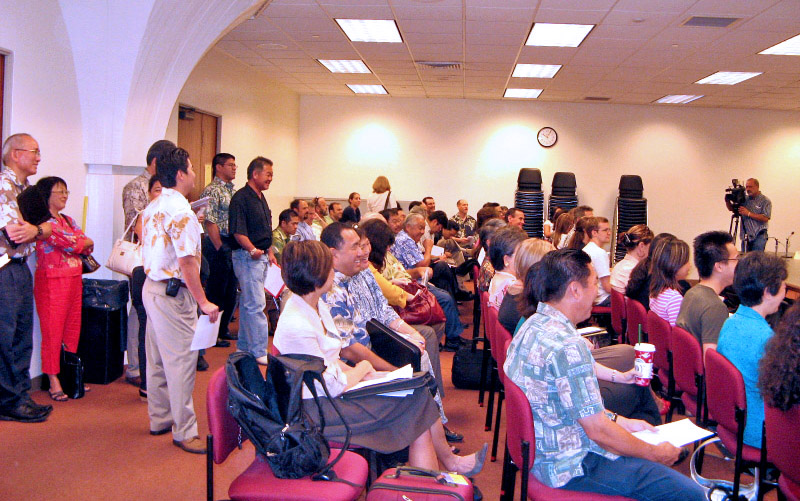
IMG_0156_1It was standing room only, with three TV cameras and several print journalists present. Clifton Tsuji, chair of the Ag Committee, told me it was very unuusal to see this many people at an informational briefing.

Although we are considered large farmers, I do not think it’s prudent to depend on a few large farms. I am also very concerned about the idea that any of Hawai‘i farmers may be hiring illegal foreign workers. This video clip shows two O‘ahu farm managers being led away in handcuffs.

This is very disappointing because while this was going on, a lot of us were down at the Capitol testifying that farmers were in trouble. In an earlier informal survey, the farm in those news articles was understood to be one of only a few farms that was doing well. But if the stories are true and that farm was doing well because of illegal activity, this is not healthy for our state agricultural industry.

I don’t think we should be relying on foreign labor in this day and age, with what’s happening to our economy (which we know will get worse before it gets better). It’s not sustainable, and more importantly we should have local people working on our farms. We can accomplish this by diversifying geographically – so that our farms are where the people, and the resources, are.

I testified Friday that it’s not rocket science. The world has changed forever, but “if farmers make money, farmers will farm.”  Farmers got in trouble earlier this year when oil prices spiked, which was only a sneak preview of what’s yet to come.

And if we have not prepared before it happens again, as we know it will, it could be disastrous for agriculture and for Hawai‘i’s food security.

We have an opportunity in the recent energy agreement between the state, HEI and the Consumer Advocate.

The legislature should add an extra incentive to farmers when the feed-in-tariff is in place by July. Besides helping farmers make money, using cutting edge technology may get the attention of younger people. No one wants to get into a business just to watch plants grow. We need action to interest the next generation. Alternate energy projects and their possibilities could provide an extra spark, especially if combined with the chance of making money.

This idea has the possibility of diversifying our food production – to farmers large and small, on all islands, at all elevations and both of the dry side and wet side of the islands. (I always say this when talking about the future of Hawai‘i’s agriculture.)

We need small farms expanding. We do not need large farms just getting bigger and bigger and gobbling up smaller farms.

Chef Alan Wong testified, too, as a restaurateur who uses local farm products in part so visitors can “taste Hawai‘i.”

Last year, a legislator tried to convince me that the card check bill – a bill that made it easier for workers to form unions – was necessary because there were abuses that I did not know of. I was not convinced.

I have changed my mind about the labor union card check bill. I feel that farms that treat their workers well should have no problems.

Simple Aquaponics

I’ve changed my mind about how we’ll use fish waste as fertilizer for hydroponic vegetables. Instead of using the University of the Virgin Islands-developed high-tech aquaponics system, I’ve decided to use Roy Tanaka’s simple “rubbah slippah” system.

The University of the Virgin Islands concept is a recirculating system using a series of pumps, aerators and bio filters. Very elegant.

But then I visited Roy Tanaka, who has been using a run of the river at his place near Papaikou for many years. He uses a small pipe which runs from a nearby river into the first tank, and then overflows into a second tank and so on. It is the essence of simplicity and common sense. He tells me that he has never had to wash his tanks because they are always clean. Free water, no electricity for pumping or aeration and no need to clean the tanks. What’s not to like about that system?

We will take a little water out of the pipe that fills our reservoir and run it through several species of aquatic animals. We are thinking of trout in the first tank and tilapia in the second, overflowing to catfish in the third, prawns in the fourth and finally crawfish in the fifth. Then, the nutrient-full overflow will go into the reservoir that supplies water for our hydroponics operation.

The effect is that we will borrow water ahead of the reservoir, run it through the fish and then put the nutrient-laden water back into the reservoir to feed our hydroponic vegetables.

We plan to start small, producing fish for our employees. As we learn about the system’s limitations, as well as what the demand might be for our products, we will increase production. We don’t, however, intend to reduce the amount we provide to our workers.

I have the utmost respect for small innovative farmers. Roy Tanaka is a perfect example of a wise and practical farmer.

Lili‘uokalani’s Translation of the Kumulipo

I just read this translation of the Hawaiian creation chant, the Kumulipo, done by Queen Lili‘uokalani. I never knew she’d translated it while under house arrest.

I was also very interested to see that in the ending paragraphs of the Introduction, she writes about Hawaiians being astronomers. This is logical when one considers that Hawaiians traveled extensively throughout the Pacific only using the stars as reference. They were the greatest navigators of their day.

I found the background, and the Introduction written by the Queen, to be fascinating. Read the full translation here. Maybe you’ll find this as interesting as I did.

The Kumulipo

Translated by Queen Liliuokalani [1897]

This is Queen Liliuokalani’s translation of the Hawaiian Creation chant, the Kumulipo. She translated this while under house arrest at Iolani Palace, and it was subsequently published in 1897. This is an extremely rare book which was republished (in a very scarce edition) by Pueo Press in 1978.

The Kumulipo’s composition is attributed to one of Liliuokalani’s eighteenth century ancestors, Keaulumoku, just prior to European contact. It is a sophisticated epic which describes the origin of species in terms that Darwin would appreciate. The Kumulipo moves from the emergence of sea creatures, to insects, land plants, animals, and eventually human beings. It describes a complicated web of interrelationships between various plants and animals. The most massive part of the chant is a genealogy which enumerates thousands of ancestors of the Hawaiian royal family.

The Kumulipo is also available at this site in the 1951 translation of Martha Warren Beckwith, with comprehensive analysis and the complete Hawaiian text. However Liliuokalani’s version is of some historical significance. The last Queen of Hawaii, Liliuokalani was extremely literate, and steeped in Hawaiian tradition. She was the author of the well-known Hawaiian anthem, Aloha ‘Oe as well as a Hawaiian history book, Hawai’i’s Story by Hawai’i’s Queen.


INTRODUCTION.

THERE are several reasons for the publication of this work, the translation of which pleasantly employed me while imprisoned by the present rulers of Hawaii. It will be to my friends a souvenir of that part of my own life, and possibly it may also be of value to genealogists and scientific men of a few societies to which a copy will be forwarded. The folk-lore or traditions of an aboriginal people have of late years been considered of inestimable value; language itself changes, and there are terms and allusions herein to the natural history of Hawaii, which might be forgotten in future years without some such history as this to preserve them to posterity. Further, it is the special property of the latest ruling family of the Hawaiian Islands, being nothing less than the genealogy in remote times of the late King Kalakaua,–who had it printed in the original Hawaiian language,–and myself.

This is the very chant which was sung by Puou, the High Priest of our ancient worship, to Captain Cook whom they had surnamed Lono, one of the four chief gods, dwelling high in the heavens, but at times appearing on the earth. This was the cause of the deification of Captain Cook under that name, and of the offerings to him made at the temple or Heiau at Hikiau, Kealakekua, where this song was rendered.

Captain Cook’s appearance was regarded by our people then as a confirmation of their own traditions. For it was prophesied by priests at the time of the death of Ka-I-i-mamao that he, Lono, would return anew from the sea in a Spanish man-of-war or Auwaalalua. To the great navigator they accordingly gave a welcome with the name of Lono.

The chanters of this great poem were Hewahewa and Ahukai, and by them it was originally dedicated to Alapai, our ancestress, a woman-chief of the highest rank, then at Koko Oahu. Keeaumoku was lying on his death-bed. The Lonoikamakahiki, of whom this chant sings so eloquently in our native tongue, is none other than Kalaninuiiamamao (Ka-I-i-mamao). His name was also Lonoikamakahiki. He was thus called by his mother, Lonomaikanaka, from the very moment of his birth. It was his grandmother Keakealani who changed his name at the time he was dedicated to the gods and the sacred tabus of the Wela, Hoano, and the Moe; or, translated, Fire, Honor, and Adoration were conferred upon him at the time when his navel string was cut at the Heiau at Nueku, Kahaluu, Kona, Hawaii. The correct name of this chief was Ka-I-i-mamao, but the bards of his day named him in their chants Kalaninuiiamamao; thus he was styled in their Mele or chant called Kekoauli-kookea ka lani. The words “lani nui” were simply inserted by them as it was their intention to hand the young prince’s name down to posterity in song, while to explain the object of the parents in naming him Ka-I-i-mamao it signified that when Keawe married Lonoma-I-Kanaka it was an infusion of a new royal blood with that of their own royal line of I, the father of Ahu, the grandfather of Lonomaikanaka. By this it was also intended to show that he, that is Ka-I-i-mamao, was above all other I’s, for there were many families, descendants of I, a high and powerful chief, and the last term, “mamao,” means “far off” and above all the rest of the I’s.

Before he was deposed by the people of Kau he was called Wakea on account of his wicked actions, and, like Wakea, he married his own daughter. By this name he wandered through the wilds of Kahihikolo at Kalihikai, Kalihiwai, and Hanalei, and ultimately became demented. Through all his wanderings he was followed by his faithful attendant and retainer Kapaihi a Hilina.

This historical character is distinct from the Lonoikamakahiki, son of Keawenuiaumi, the same one who challenged Kakuhihewa at checkers, Konane. He figured at a different period. There were really three persons of the name of Lonoikamakahiki; the first of these was the son of Keawenuiaumi; the second was a celebrated hunchback son of Kapulehuwaihele, and belonged to Makakaualii. The third Lonoikamakahiki is the one for whom this prayer was composed. His parents were Keaweikekahialiiokamoku and Lonomaikaamaka. Ka-I-i-mamao was the father of Kalaniopuu, this last-named being ancestor in the third degree of King Kalakaua, who reigned over the Hawaiian kingdom from 1874 to 1891, and of Liliuokalani, who reigned from 1891 to 1893. He was also ancestor in second and third degree to the wife of Kalakaua, at present the dowager Queen Kapiolani.

It will be seen, therefore, that as connecting the earlier kings of ancient history with the monarchs latest upon the throne this chant is a contribution to the history of the Hawaiian Islands, and as it is the only record of its kind in existence it seemed to me worthy of preservation in convenient form.

I have endeavored to give the definition of each name as far as it came within my knowledge of words, but in some cases this could not be done because the true signification has been lost. The ancient Hawaiians were astronomers, and the terms used appertained to the heavens, the stars, terrestrial science, and the gods. Curious students will notice in this chant analogies between its accounts of the creation and that given by modern science or Sacred Scripture. As with other religions, our ancient people recognized an all-powerful evil spirit: Mea was the King of Milu as Satan is of the infernal regions, or hell.

I hope that to some interested in all that pertains to Hawaii, this may give one-half the pleasure which it gave to me in the translation and preparation of the manuscript.

LILIUOKALANI, of Hawaii,      
Patron of the Polynesian Historical Society.

Farmers & Renewable Energy

I’ve talked about energy and I’ve talked about agriculture, but everybody who makes decisions about agriculture and energy operates in a vacuum. If it’s energy, they only talk about energy. If it’s agriculture, they only talk about agriculture.

To make it work, we need to get the two together.

The recently announced energy agreement is a first step in the right direction – for energy purposes. Now we need to add an agricultural component to it, which they cannot do because they’re all about energy. We need the legislature to marry the two together.

Everybody agrees about renewable energy. What we need to do now is give farmers really strong incentives to put in renewable energy projects, because that will help them be energy secure and then we won’t have to beg people to “Please Buy Local.” Local farmers will be able to set their prices lower, and people will buy local farmers’ goods based on their merits. We won’t have to go through all the gnashing of teeth and wringing of hands to get people to “buy local.”

We need to pay farmers to do small energy projects; encourage them to do renewable energy. Maybe we give them ten percent more than we give others? The benefit is that you get energy plus food. That’s what it will take to be sustainable.

You can’t just be sustainable in energy and not in food.

Giving farmers extra incentives to use renewable energy methods achieves two things – it helps them save/make money and produce more food per person, while also achieving the goal of bringing more renewables on line. We know that “If the farmer makes money, the farmer will farm.”

The world has changed and we need to adapt to a new reality. The challenge for Hawai‘i is figuring out how to become food and fuel secure with the least amount of pain.

This crash course explains what is going on in our changing world in a very simple, commonsense way. Its explanations are among the easiest to understand that I’ve seen.

Because of our abundant natural resources here in Hawai‘i, we have the opportunity to have a relatively better lifestyle than that of the U.S. mainland. Net Energy Return On Energy Invested (NEROEI), minus the energy used to produce food, gives us our lifestyle. Therefore, in order to maximize our lifestyle, we need to focus our attention on both renewable energy as well as food production.

It is prudent for us to prepare for the worse and hope for the best.

If we join agriculture policy to energy policy we will have both food and energy locally produced, and that is the essence of sustainability.

Not “no can,” “CAN!”

The Kohala Ditch Flows Again!

My friend Duane Kanuha forwarded me this email from Bill Shontell, the project manager for Surety Corp. It’s about the Kohala Ditch water flowing. This is a huge project that’s been a tremendous amount of work and a long time coming.

I wrote about the project a couple months ago when I took a helicopter tour of the area.

Here’s the note from Bill:

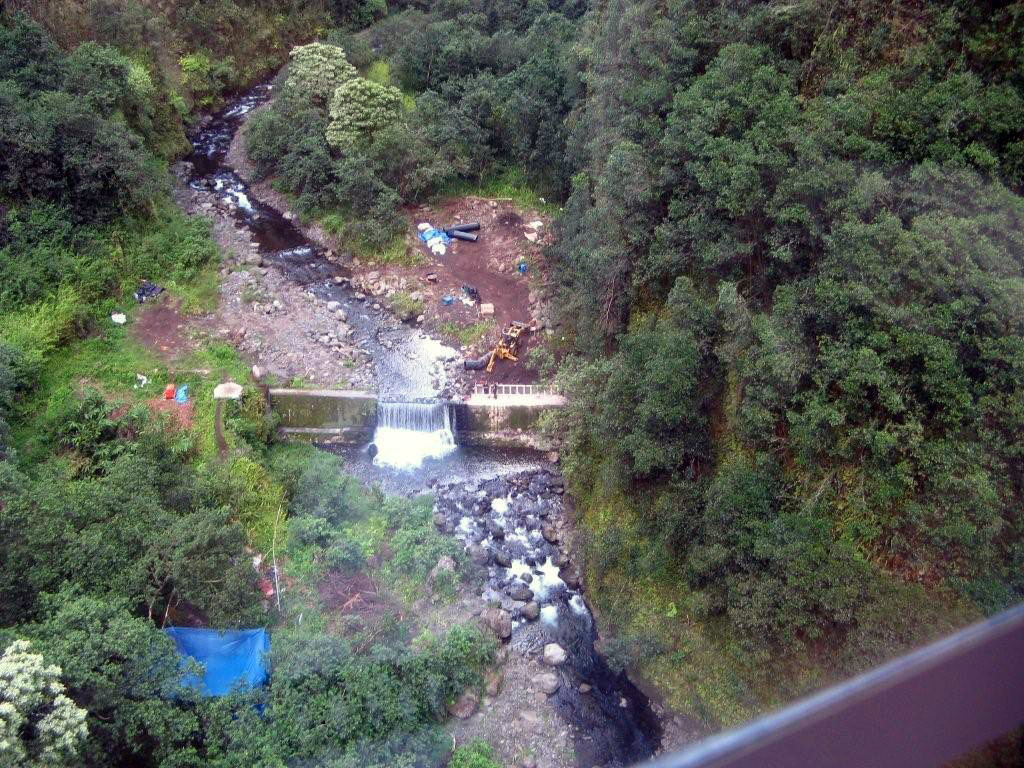
FYI, we released the waters of Honokane Nui through new Flume #1 this afternoon about 2:30. The intake is working fine and the flume is currently conveying water across Honokane West Branch, through the ridge of Kupehau, and into Pololu Valley.

On Monday the 24th, we will throttle down the valve at the intake, remove two temporary access ramps in Pololu and Niulii and on Tuesday the 25th, at 3 pm, we will release water into the balance of the system.

Just in time for Thanksgiving.

Kohala ditch Pau 11-21-08

Here I am in September, getting ready to go see the origin of the Kohala ditch at Honokane Nui.

Kohala ditch 006

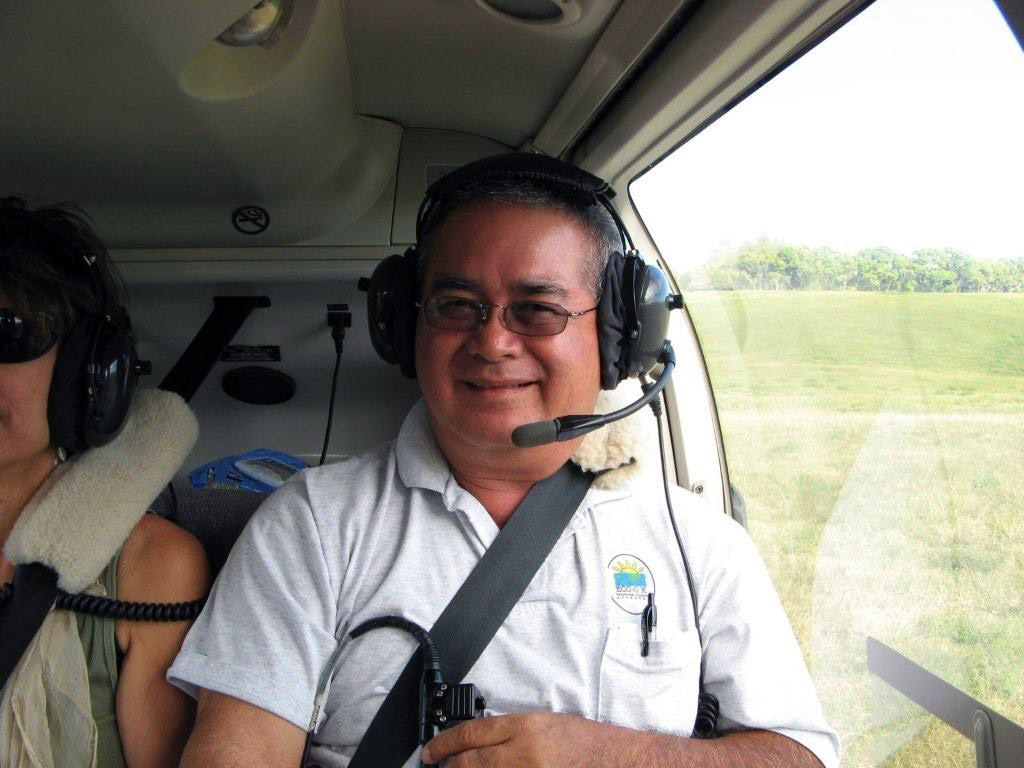
The crew that works in the valley. That’s Rick Gordon in the middle and Bill Shontell on the right. Our helicopter pilot is at left.

Kohala ditch 049

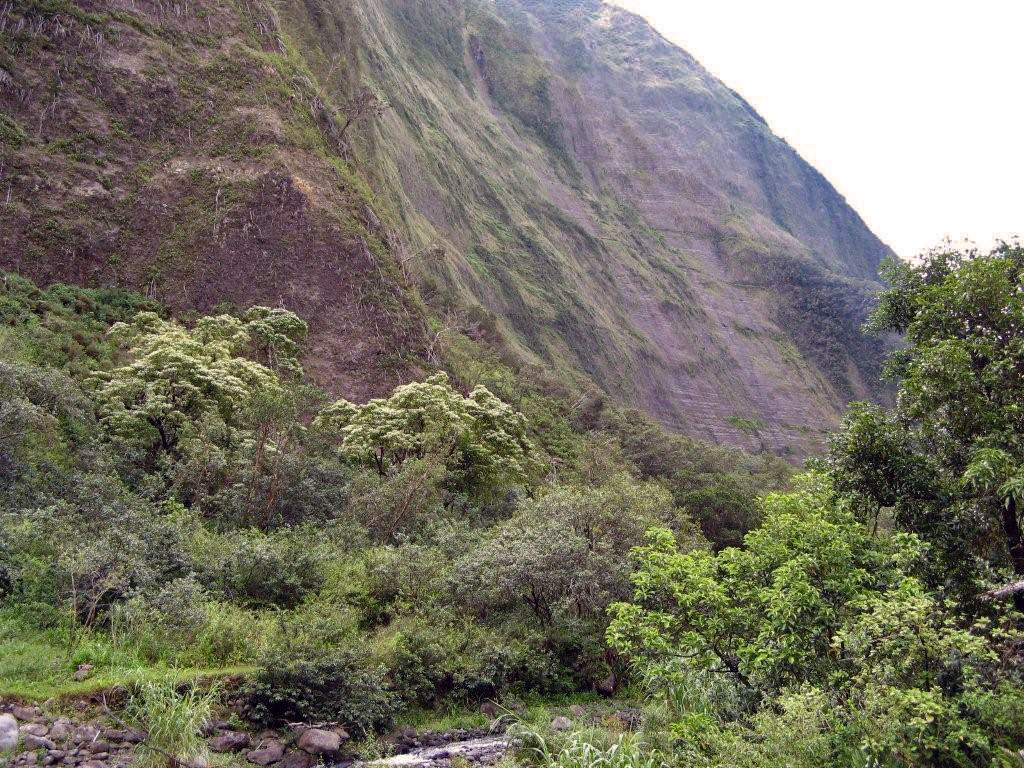
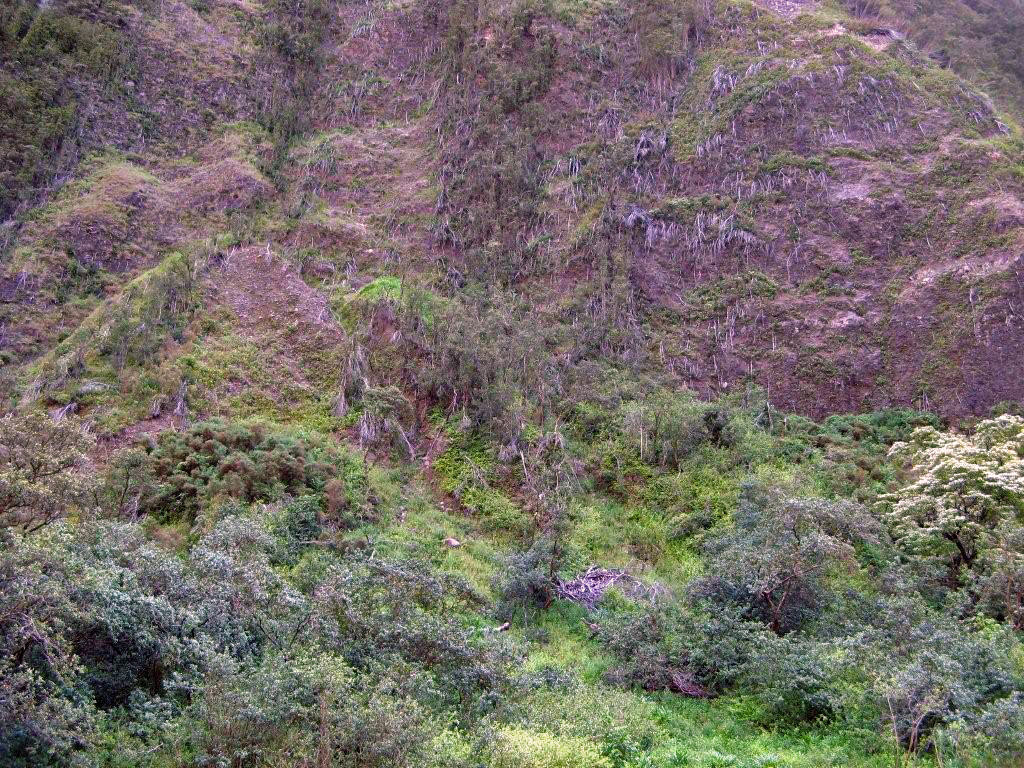
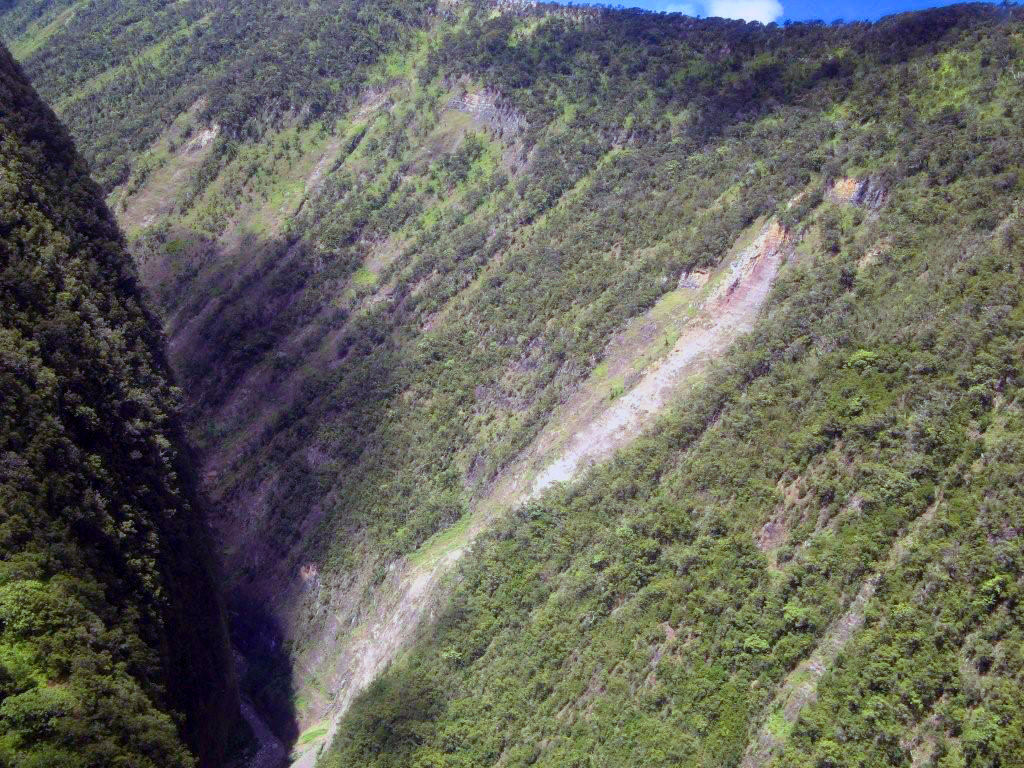
This entire cliff face fell in with the 2006 earthquake that destroyed the ditch. 

Kohala ditch 058

Kohala ditch 057

View of the repair work going on at the dam at Honokane Nui. That day, a loose stone fell off the cliff and glanced off one of the workers. 

Kohala ditch 073

Lifting up and out of the valley. We were way down there at the stream level. What a trip.

Kohala ditch 084

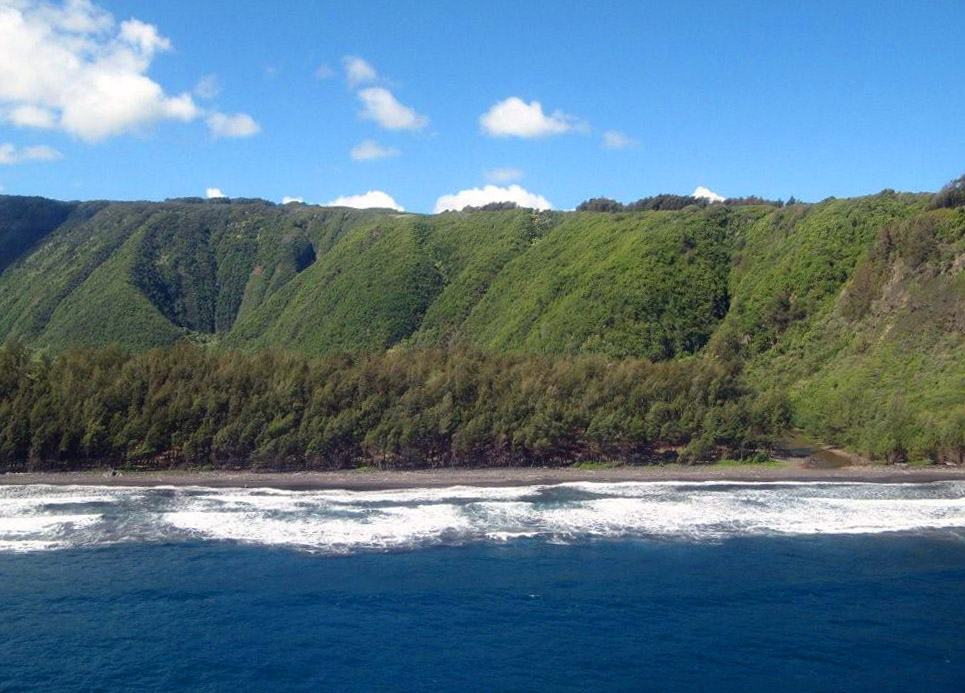
The mouth of Pololu Valley.

Kohala ditch 100

[Leslie’s note: I went looking for something I could link to, something that would tell the story of what happened to the historic and important Kohala Ditch during the October 2006, 6.7 earthquake, and I found, um, this magazine article. Which I wrote, and Macario photographed, and which I had sort of forgotten about. Which tells you something about the state of my mind.]

Acting Now For the Future (Re: Sustainability)

I sat on a panel discussion yesterday at the Hawaii Energy Challenge 2008, which was held at the Fairmont Orchid at Waikoloa.

Derek Kurisu of KTA Superstores and I were there representing the topic of Food Security. Steve Bowles represented Water Security; Tony Hanley, Matson’s Director of Sales and Marketing, Ocean Freight; Nani Lee, Executive Director of the Food Basket, Social Services; Peter R. Ingram, who is Executive Vice President of Hawaiian Airlines, Business, & Randy Perreira, Executive Director of HGEA, Unions.

It was very easy and conversational, though the subject was serious. We talked about how the new energy agreement with the state, HEI and the Consumer Advocate would impact our sectors. The panelists all recognized that current, low oil prices are temporary, and that we need to act now for the benefit of future generations.

I told them the Farm Bureau is in crisis management this month because many farmers are going out of business due to rising energy costs this past year.  I told them it’s not rocket science. “If farmers make money, farmers will farm.”

I also talked about how we were able to get a renewable energy farm loan bill passed this last session of the legislature. Energy projects are mostly infrastructure, and financing with cheap money is very attractive to farmers. There’s no fertilizing, pruning or harvesting – you just build it and make and/or save money. Its objective, I explained, is to help farmers make a little money so they can be competitive with imported products. This, I said, might help us with future food security. “If the farmer makes money, the farmer will farm.”

Nani Lee of the Food Basket told us that the number of clients served by the Food Basket has increased from 18,000 a month last year to close to 36,000 a month now. I mentioned that we were able to donate thousands of pounds of bananas before the recession; but now we are not able to.

She went on to ask if everyone understands what “Malama ‘Aina” meant. She talked about how Hawaiians look at things with a long-term perspective. They consider many generations from the present.

I told the audience that I agreed with Nani – that we must have a long-term perspective. And to that end, we must make sure that agriculture is included in any energy plan that is developed. I told them a person can avoid using a utility, but we cannot do without food. So it is paramount that we include food when we plan for the future.

It felt good being part of a group trying to do what is best for future generations. Everyone interacted for the greater good.

It was quite a contrast with the Comprehensive Management Plan meeting held at Keaukaha Elementary School the other night. There, the people were angry and distrustful of the University of Hawai‘i. One cursed the children of the Hawaiian moderator. Another said she was going to be a certain researcher’s worse nightmare. Another just swore at the UH people.

I try to understand how people can feel so abused that they would do those kinds of things to their brothers and sisters. And I still don’t understand it.

By contrast, the people at yesterday’s meeting, where there were a fair number of Hawaiians in the audience, were happy to share what they know. I enjoyed this conference where everyone seemed to be moving, together, down the road to the future.

But still, I imagine that the people who were so passionate against the University of Hawai‘i the other night could have absolutely made a difference in this important forum yesterday. Their weight and passion would have had a major impact.

After the E Malama ‘Aina Sustainability Festival

Richard Ha writes:“Phew, that was a journey,” says Roland Torres, producer of the television program Kama‘aina Backroads.

He’s talking about the E Malama ‘Aina festival, which he helped us organize and publicize. It was this past weekend, at Mo‘oheau Park near the Hilo bayfront, and it turned out terrific.

“It fills my soul with satisfaction,” says Roland, “what we accomplished — creating an open, positive space where any and everyone was able to explore, learn, and gain inspiration for life. The crowds of visitors, the folks manning the booths, the aunties enjoying the nahenahe music, the wonderful array of food (the malasadas ran out, they made more batches, and then they ran out again) made for a joyous day. Even Ke Akua seemed to put a handprint on the event by giving us one of the most beautiful Hilo days you’ll ever experience in November. I didn’t want it to finish.”

It was an important event. The world is changing, and because we live on an isolated island we need to start to do the things necessary to prepare ourselves to be self-sufficient.

 Steve Shropshire and I, co-chairs of the event, wanted to bring like-minded people together, in one place, so the general public could come and see what people are doing to prepare for the future and maybe get some ideas.

People are doing so many interesting things toward increased
sustainability! When things start to get tough we want people to
know they are not alone -– that their fellow citizens are preparing, and the future is hopeful.

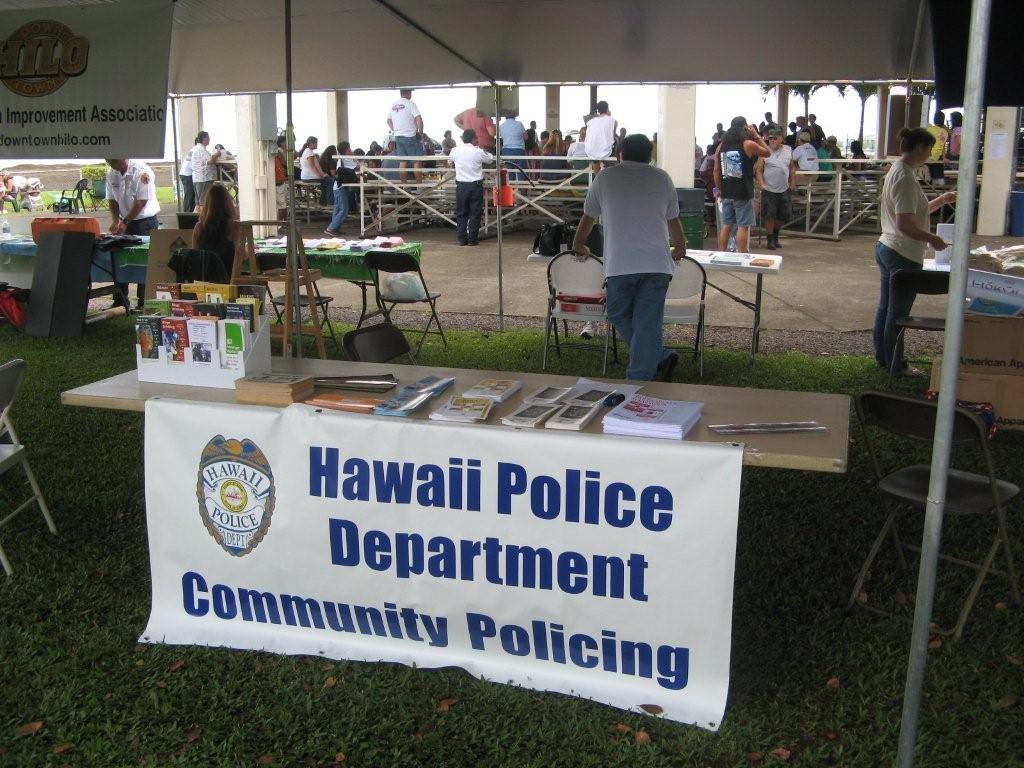
Here’s the HQ tent for information and a support center.There were  police in the crowd, the County Fire Departments EMTs on the left. In the bandstand there was a robotics competition going on.

Police tableSam Pulu‘ole and Koran Munafo of the Downtown Improvement Association made sure everything ran smoothly.

And there was live entertainment in the bandstand. Some of
the best Hawaiian entertainers there are donated their time (our thanks to Roland Torres for arranging the entertainment). Performers included Pu’ulena (Puna and Princess Keli’iho’omalu and Kawika Ka’awaloa), Ikaika Marzo, Keoki Kahumoku, Kainani Kahaunaele, Brittni Paiva and Na Palapalai (Ku’ana Torres and
Kehau Tamure).

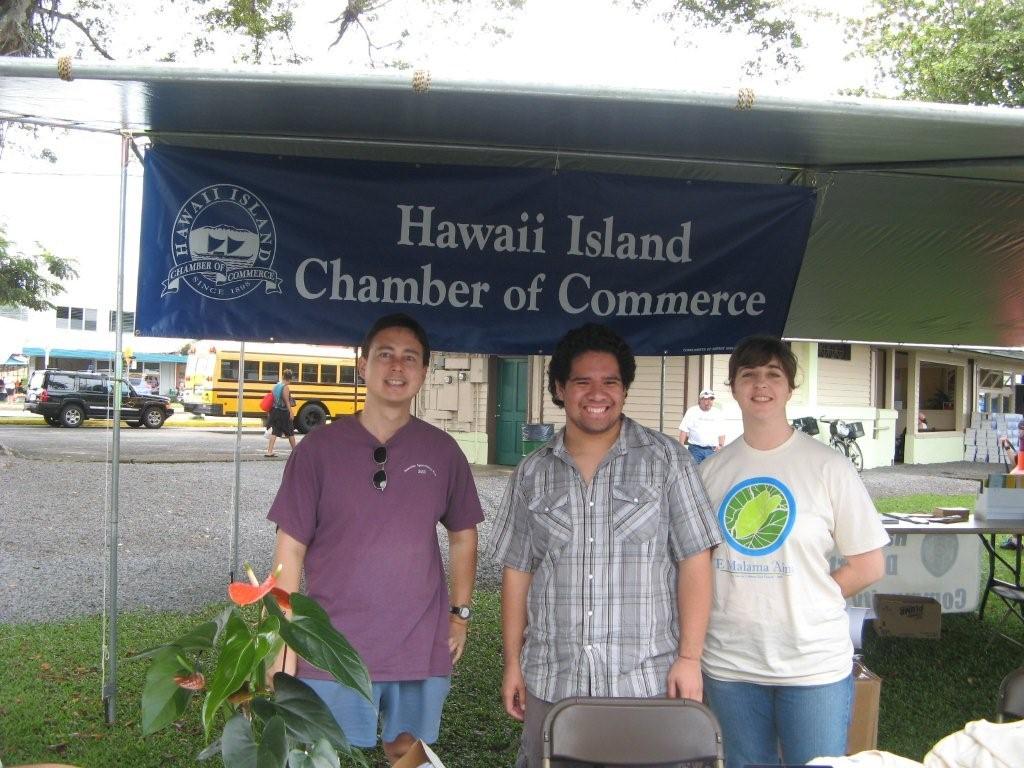
The Hawai‘i Island Chamber of Commerce, along with the
County of Hawai‘i’s Research & Development R&D department, were the festival’s primary sponsors. Below, volunteers from the Chamber of Commerce. Not shown: Executive Director Judi Steinman and Daniel Krause made sure all the loose ends were tied up.

Chamber volunteers

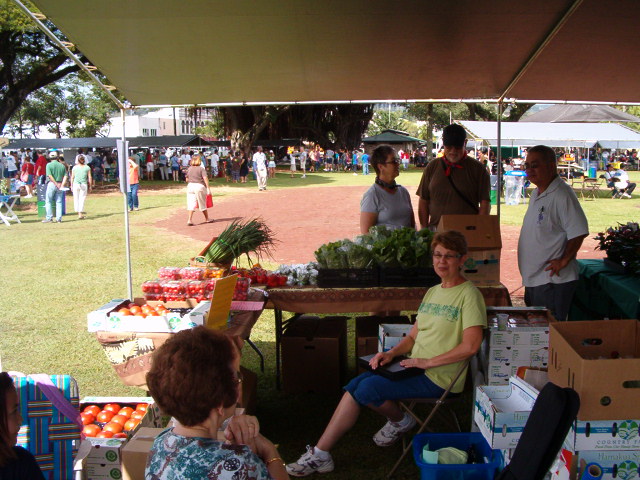
Here’s June at our Hamakua Springs Country Farms booth.

HSCF

 And there was great food. Our thanks to Sonia Martinez for
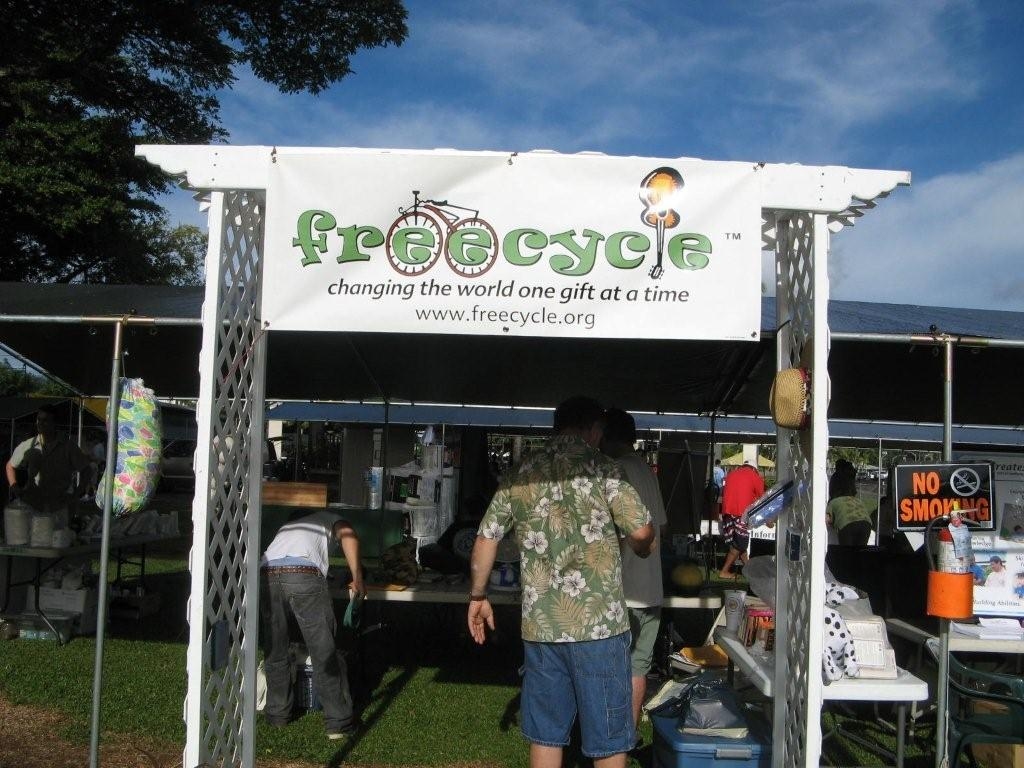
organizing the really good food! She also had a Freecycle.com booth.

Freecycle

 We are going to talk with some of the participants after the
fact here and in the coming weeks we will bring you some stories about what you saw there (or missed). Stay tuned to the blog.

 (Have you subscribed to our RSS feed? Click on the link at the bottom of the right hand side of the blog to automatically receive all our new posts.)

Meetings re: Draft of Mauna Kea Comprehensive Management Plan

The Mauna Kea Comprehensive Management Plan – review the CMP summary here – is, in my opinion, a strong attempt to malama (take care of) Mauna Kea.

The Comprehensive Management Plan (CMP) process was begun by the Office of Mauna Kea Management long before Judge Hara required it be put together. I know, personally, that the individuals who developed it had the best interests of Mauna Kea in mind. This plan was not driven just to accommodate the Thirty-Meter Telescope.

While it’s true that individuals have different ideas as to how Mauna Kea should be taken care of, what we share is that we all want it done properly.

Project Overview

State law defines a “management plan” as a comprehensive plan for carrying out multiple land uses. The Comprehensive Management Plan for Mauna Kea, therefore, is a management plan that will specifically address multiple land uses on those lands managed by the University of Hawai’i (UH) on Mauna Kea.
The CMP will provide a management framework for the Office of Mauna Kea Management (OMKM) to address existing and future activities on these conservation lands, with the goal of protecting Mauna Kea’s significant cultural and natural resources. The CMP will build upon the previous management and master plans to update the management strategies for the range of activities on and uses of Mauna Kea. The CMP will include detailed information about natural and cultural resources, including management recommendations to ensure their protection, by incorporating plans currently being prepared by OMKM consultants. It will also consider how to process and manage existing and potential future uses of and activities on Mauna Kea, such as astronomy, recreational and commercial activities, scientific research, and cultural and religious activities.

The draft Comprehensive Management Plan incorporates suggestions from the general public that were gathered at a series of talk story sessions, community meetings and forums.

Now there will be a series of three meetings, as well as individual talk story sessions, for the general public to provide more input to the final document. At this second round of public meetings, Ku’iwalu intends to present a draft of management recommendations for the CMP for community review.

Upcoming Meetings
Kona Community Meeting (Round 2)
Friday, Nov. 14, 2008 5-8 p.m.
Kealakehe Elementary School
74-5118 Kealakaa Street Kailua-Kona, Hawai‘i 96740
Waimea Community Meeting (Round 2)
Monday, Nov. 17, 2008 5 – 8 p.m.

Waimea Civic Center
67-5189 Kamamalu Street Kamuela, Hawai‘i 96743
Hilo Community Meeting (Round 2)
Tuesday, Nov. 18, 2008 5:30 – 8:30 p.m.
Keaukaha Elementary School
240 Desha Avenue Hilo, Hawai‘i 96720

These presentations give the public another opportunity to provide comments on the proposed Comprehensive Management Plan for Mauna Kea.