All posts by Richard Ha

Is The Sierra Club Anti-Hawaiian?

This is an email that I sent to Mark Glick, President of the Hawaii Sierra Club.

Aloha Mark:

It saddens me to write this note to you. I am a member of the Sierra Club. But I very much disagree with the stance that the Sierra Club has taken with regard to Mauna Kea.

There are many, many dedicated volunteers in the Moku Loa group and I enjoy participating in conservation committee meetings. But, If the Sierra Club sues, I will regretfully have to terminate my membership.

I am native Hawaiian and the overwhelming number of native Hawaiians are in favor of the Comprehensive Management Plan and the development of the Thirty Meter Telescope on Mauna Kea. We feel that it is appropriate that the best telescope in the world be built on the most sacred mountain in the world, in honor of our proud history of astronomy and navigation. I feel that the Sierra Club has no regard for what the vast majority of  the Hawaiian people feel.

When the Thirty Meter Telescope corporation first announced that they were interested in coming to Hawaii, I volunteered to be on the TMT committee of the Hawaii Economic Development Board. I was disappointed and angry about how astronomy had been done on the mountain.  And I was determined that if it was to be done, I wanted a hand in making sure that it be done right.

Previous to this I had been just a banana farmer. But when one talks about Mauna Kea, one needs to talk about the culture. And then, one gravitates to Keaukaha, the oldest Hawaiian Homes community of the Big Island. There I discovered that although there were hundreds of millions of dollars of telescopes on the mountain, there were no visible benefit to the Hawaiian community. This community has a much lower average income than Hilo proper.
One day, I asked Kumu Lehua Veincent, the principal of Keaukaha Elementary School: Where do the kids go on excursion? He said, We do not have enough money to rent buses, so we organize walking excursions around the neighborhood. How could this be? I thought that all kids went on excursion.

A friend of mine and I decided that we could not just talk, we needed to do something and so we started the adopt-a-class project. We figured that $300 would be enough to rent a bus and $300 would pay for entry fees to Imiloa the Astronomy and Hawaiian culture museum. So, we went around and asked if individuals or groups would be interested in adopting a class so they could go on excursion. In four months all the classes were adopted for both semesters.

Soon after, the Moore Foundation, using the adopt-a-class project as a template, funded all the students on the Big Island for an excursion to Imiloa.

You may know that Hawaiians occupy the lowest rungs of the economic ladder. And that the best predictor of family income is level of education. The TMT committed to fund $1 million annually to a keiki education fund as soon as permits are issued. We have an opportunity of elevating our Hawaiian childrens’ education level and to move them up in our society.

The Sierra Club fighting against this project, when we and so many others fought so hard to make the CMP pono, is so disappointing as to be beyond words. Your stance is anti-Hawaiian.

What is your justification for doing this? What does the national chapter think?  How can you even contemplate it?

Aloha,
Richard Ha

Governor Lingle and Grandma

Governor Linda Lingle came to visit us at the farm a couple of days ago.  The first thing I wanted to be sure of was that Grandma would be there. And I wanted to tell the governor that we could not have done this without June’s help and support.

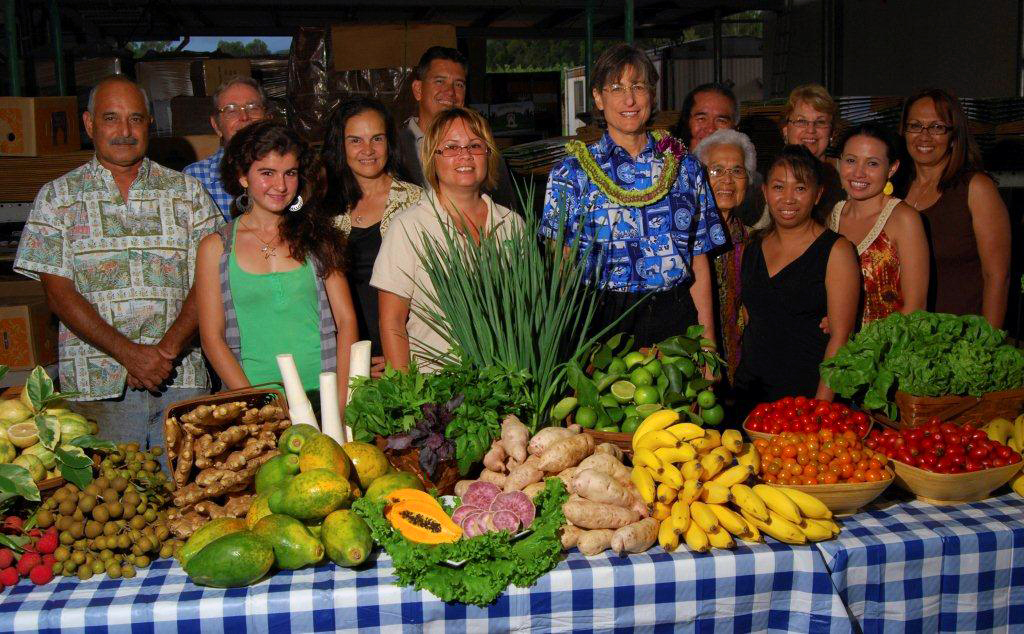
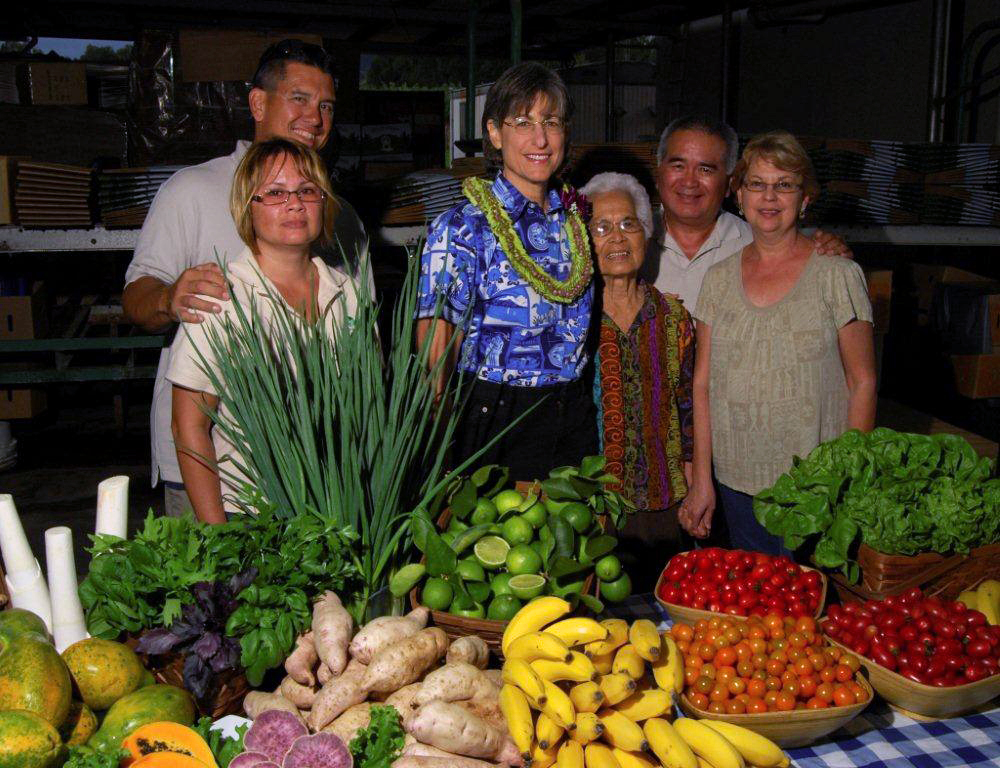
Grandma & the governorKimo and Tracy Pa on the left; June and I on the right. Three generations of us in front of the camera. Our grndson Kapono Pa, the fourth generation, is behind the camera.

In the picture, I think Grandma and the governor have their arms around each other, and June is holding Grandma’s other hand. That made me smile.

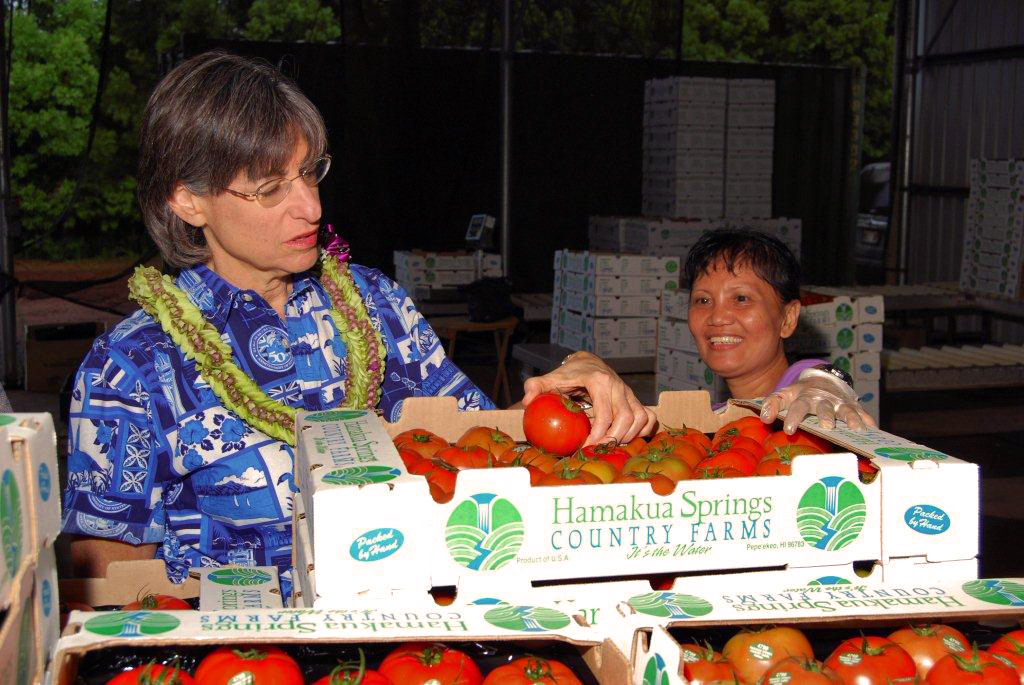
First we went to see the tomato packing house workers, and the varieties of tomatoes we grow. I explained that our view of sustainability involves our workers, our community and the environment; and that food security is about farmers farming. “If farmers make money, farmers will farm.”

Lingle
The Governor loves Hamakua Springs tomatoes

Ted Liu, Director of the Department of Business Economic Development and Tourism, asked me to give the governor an overall view of our farm. I explained that we have approximately 60 workers and that the farm consists of 600 fee simple acres in production. We have an annual rainfall of 140 inches and we have three springs and three streams running through the property. On our farm, we have the equivalent of about one-thirds of the water that flows through the Waiahole ditch to supply the Ewa Plains on O‘ahu. And we are in the process of building a hydro-electric plant, which will provide all the farm’s electricity. It will be able to continuously power fifteen 40-foot Matson reefers.

I explained that we started banana farming by trading banana pulapula for chicken manure and that we have transformed our business many times in our 30 years of business. So transforming ourselves is second nature to us.

When gas prices went up in mid-2008, several of our workers asked to borrow money for gas. That was very worrisome.

So we are transforming ourselves again. Instead of being the only large farmer on 600 acres, we are leasing land to area farmers. In the future, we won’t have many workers that live far away. And we won’t need to worry about workers’ housing.

We are offering area farmers a reasonable rent, and we are intending to provide water and electricity to the farmers at a very reasonable price. We know that if the farmers can make money, the farmers will farm. And if they make money, then we can make money distributing their products and then the retailers will get a steady supply of product to feed Hawai‘i’s people. With cheap electricity from the hydro plant, we can control our, and the farmers’, cooling costs.

Group We grow tomatoes, bananas, herbs and lettuces. Other farmers grow cucumbers, apple bananas, sweet corn, sweet potatoes and ginger. In addition, we market papaya, lemons, limes, longan, lychee, heart of palms and more.

We went over to look at the tilapia we are experimenting with. We think that in a future of rising oil prices, fish food will not be cheap and transporting frozen fish around the world will be expensive. So we are experimenting with growing fish using free running water, so we won’t need to use electricity for aeration or hormones and antibiotics. We are experimenting with using waste from our farm operations for feed. At some point in the future, this will become economical to do. We have all the natural resources and the vegetable waste to use. We plan to use the fish waste for fertilizer for downstream plants. When the time is right, we can scale up to any size that makes sense.

We went back to the main packing house, where June introduced the governor to some of the farmers, who then had a chance to chat with her. I explained that Kimo Pa is the farm manager, and that he and our daughter Tracy represent the next generation of farmers.

Lingle & ida castillo
Governor Lingle with Ida Castillo

I told the governor that we are pushing for geothermal by having community meetings and talking to people, as we did early on for the TMT. She agreed that geothermal makes a lot of sense and said she would support us.

She mentioned to Ted Liu that we were “actually doing it.” I took it to mean that she thought we are doing something about Hawai‘i’s food security, rather than just talking about it. It was a nice, pleasant visit that we all enjoyed.

‘A Global Economy is An Oily Way to do Business’

Jeff Rubin says oil prices will rise but that we can cope if we do the right things. I too, believe that we can adapt.

Rubin was the chief economist at CIBC World Markets for almost twenty years. He was one of the first economists to accurately predict soaring oil prices back in 2000, and now he is now a sought-after energy expert.

I like what Jeff Rubin has to say:

“If we continue to commute 60 miles each way in SUVs, we’re going to get screwed. All of a sudden, peak oil will equal peak GDP; that’s not just an economic recession for a couple of quarters, that’s a world of no economic growth. The point of my book is that, while we can’t do anything about triple-digit oil prices, there’s a whole lot we can do to make sure that when we encounter triple-digit oil prices, they don’t have to be so devastating as in the past.

“We have to reduce, in effect, oil per unit of GDP, and the way we do that is to go from a global economy back to a local economy because a global economy is an extremely oily way of doing business. And that switch isn’t something that the Federal Reserve Board or US Treasury or the Bank of Canada or the European Central Bank is going to put in place; that is going to be the aggregate result of all the micro decisions that consumers make about what we eat, where we live and how we get around.

“I think triple-digit oil prices will lead us to make the right decisions on those fronts, and the result will be a very different economy than the economy we know.”

What is Plan B? Plan C?

Do you remember that prior to the climate change conference this past December, the Environmental Protection Agency (EPA) declared that greenhouse gases endanger human health? I heard it!

This means that, at anytime, the EPA can declare greenhouse gases – including C02 – are harmful to human health, and it could impose penalties.

The U.S. Congress is now getting ready to pass climate change legislation. Whatever they pass, our electric utilities will likely be penalized for emitting C02 – whether they burn fossil or biofuel.

This is why I ask: “What if the EPA designates C02 a dangerous gas? What is Plan B? Plan C?”

I’ve also been noticing that Europe and now the East Coast of the U.S. are slowly coming to the conclusion that biomass is not C02 neutral. In fact, they are finding that it could be as harmful as coal as far as C02 emissions are concerned.

It turns on if it is used for collecting and burning waste branches and rubbish, instead of trees. It also has to do with how long the rotation of new trees takes. Hu Honua is planning to burn eucalyptus trees, which might put it in the EPA’s gun sights. Organizations need to be out in front of these issues.

To be clear, I am in favor of PV, wind, algae and biofuels for transportation. What I am talking about here, though, is “base power” for electricity. “Base power” is the largest part of the electric utilities’ usage.

I also believe that each grid needs to find its own solution. I am mostly talking about the Big Island grid.

Which brings us back to this Lloyd’s of London white paper I just wrote about here. The world has changed and yesterday’s decisions may not be applicable to tomorrow’s reality.

It is no secret that I believe that geothermal moves us out of the line of fire.

I believe that the changes coming upon us, as the Lloyd’s of London analysis points out, are serious and will take place before any geothermal event.

We will soon find out who our true leaders are.

Lloyds of London says ‘Expect $200/Barrel Oil by 2013’

Lloyds of London just issued a  White Paper on Sustainable Energy Security. It is a paper addressed to businesses and it says everything I’ve been saying for the last couple of years.When I attended those two Peak Oil conferences, it was because I wanted to learn how to position my business for the future. And I did.

Here is a formal road map that other businesses can follow. Modify the information to allow for Hawaiian conditions.  

Strategic risks and opportunities for business
Executive summary
 

1. BUSINESSES WHICH PREPARE FOR AND TAKE ADVANTAGE OF THE NEW ENERGY REALITY WILL PROSPER – FAILURE TO DO SO COULD BE CATASTROPHIC
Energy security and climate change concerns are unleashing a wave of policy initiatives and investments around the world that will fundamentally alter the way that we manage and use energy. Companies which are able to plan for and take advantage of this new energy reality will increase both their resilience and competitiveness. Failure to do so could lead to expensive and potentially catastrophic consequences.

What if the EPA declares CO2 a dangerous gas? What is plan B? C?

 2. MARKET DYNAMICS AND ENVIRONMENTAL FACTORS MEAN BUSINESS CAN NO LONGER RELY ON LOW COST TRADITIONAL ENERGY SOURCES
Modern society has been built on the back of access to relatively cheap, combustible, carbon-based energy sources. Three factors render that model outdated: surging energy consumption in emerging economies, multiple constraints on conventional fuel production and international recognition that continuing to release carbon dioxide into the atmosphere will cause climate chaos.

This means that people will need to bite the bullet and accept the high cost of renewable fuels. But what if we have the opportunity for cheap renewable electricity? And what if this means that we can elevate the living standards of the host Hawaiian culture? Should we turn it down, or should we fight for it?

Geothermal is cheap and renewable and, compared to fossil fuels, bio fuels and bio mass alternatives, it is environmentally friendly. Of course we should fight for it!

3. CHINA AND GROWING ASIAN ECONOMIES WILL PLAY AN INCREASINGLY IMPORTANT ROLE IN GLOBAL ENERGY SECURITYChina and emerging Asian economies have already demonstrated their weight in the energy markets. Their importance in global energy security will grow. First, their economic development is the engine of demand growth for energy. Second, their production of coal and strategic supplies of oil and gas will be increasingly powerful factors affecting the international market. Third, their energy security policies are driving investment in clean energy technologies on an unprecedented scale.
 
China in particular is also a source country for some of the critical components in these technologies. Fourth, as ‘factories of the world’, the energy situation in Asian countries will impact on supply chains around the world.
 
4. WE ARE HEADING TOWARDS A GLOBAL OIL SUPPLY CRUNCH AND PRICE SPIKE
Energy markets will continue to be volatile as traditional mechanisms for balancing supply and price lose their power. International oil prices are likely to rise in the short to mid-term due to the costs of producing additional barrels from difficult environments, such as deep offshore fields and tar sands. An oil supply crunch in the medium term is likely to be due to a combination of insufficient investment in upstream oil and efficiency over the last two decades and rebounding demand following the global recession. This would create a price spike prompting drastic national measures to cut oil dependency.

With every year that goes by, the world’s oil fields are aging at the rate of 4 million barrels per day. Saudi Arabia produces only 10 million barrels per day. This means that every 2½ years we need to have found the equivalent of a Saudi Arabia. Are we doing this? NO! We have not found giant oil fields like Saudi Arabia since the 1970s. We have not found enough to make up the natural aging of oil fields.
 
It is estimated that we will only be able to produce half of the 4 million barrel decline. This means that in less than two years, once our extra capacity runs out, we will be short two million barrels per day.

Supply constraints will drive up the price of oil.

“A supply crunch appears likely around 2013…given recent price experience, a spike in excess of $200 per barrel is not infeasible.” Professor Paul Stevens, Chatham House.

5. ENERGY INFRASTRUCTURE WILL BECOME INCREASINGLY VULNERABLE AS A RESULT OF CLIMATE CHANGE AND OPERATIONS IN HARSHER ENVIRONMENTS

Much of the world’s energy infrastructure lies in areas that will be increasingly subject to severe weather events caused by climate change. On top of this, extraction is increasingly taking place in more severe environments such as the Arctic and ultra-deep water. For energy investors this means long-term planning based on a changing – rather than a stable climate. For energy users, it means greater likelihood of loss of power for industry and fuel supply disruptions.
 
6. LACK OF GLOBAL REGULATION ON CLIMATE CHANGE IS CREATING AN ENVIRONMENT OF UNCERTAINTY FOR BUSINESS, WHICH IS DAMAGING INVESTMENT PLANS
Without an international agreement on the way forward on climate change mitigation, energy transitions will take place at different rates in different regions. Those who succeed in implementing the most efficient, low-carbon, cost-effective energy systems are likely to influence others and export their skills and technology. However, the lack of binding policy commitments inhibits investor confidence. Governments will play a crucial role in setting policy and incentives that will create the right investment conditions, and businesses can encourage and work with governments to do this.
 
7. TO MANAGE INCREASING ENERGY COSTS AND CARBON EXPOSURE BUSINESSES MUST REDUCE FOSSIL FUEL CONSUMPTION
The introduction of carbon pricing and cap and trade schemes will make the unit costs of energy more expensive. The most cost-effective mitigation strategy is to reduce fossil fuel energy consumption. The carbon portfolio and exposure of companies and governments will also come under increasing scrutiny. Higher emissions standards are anticipated across many sectors with the potential for widespread carbon labelling. In many cases, an early capacity to calculate and reduce embedded carbon and life-cycle emissions in operations and products will increase competitiveness.
 
8. BUSINESS MUST ADDRESS ENERGY-RELATED RISKS TO SUPPLY CHAINS AND THE INCREASING VULNERABILITY OF ‘JUST-IN-TIME’ MODELS
Businesses must address the impact of energy and carbon constraints holistically, and throughout their supply chains. Tight profit margins on food products, for example, will make some current sources unprofitable as the price of fuel rises and local suppliers become more competitive. Retail industries will need to either re-evaluate the ‘just-in-time’ business model which assumes a ready supply of energy throughout the supply chain or increase the resilience of their logistics against supply disruptions and higher prices. Failure to do so will increase a business’s vulnerability to reputational damage and potential profit losses resulting from the inability to deliver products and services in the event of an energy crisis. 

We have changed our business model to give our customers the opportunity to shorten their supply chain. And we have included many small farmers in order to make ourselves more resilient, which benefits our customers (the retailers).
 
With our hydroelectric plant, we will immunize ourselves from the increasingly risky and unstable fossil fuel infrastructure.
 
HECO should go to geothermal faster, rather than slower, in order to accomplish the same thing.

9. INVESTMENT IN RENEWABLE ENERGY AND ‘INTELLIGENT’
INFRASTRUCTURE IS BOOMING. THIS REVOLUTION PRESENTS HUGE OPPORTUNITIES FOR NEW business PARTNERSHIPS
The last few years have witnessed unprecedented investment in renewable energy and many countries are planning or piloting ‘smart grids’. This revolution presents huge opportunities for new partnerships between energy suppliers, manufacturers and users. New risks will also have to be managed. These include the scarcity of several essential components of clean energy technologies, incompatible infrastructures and the vulnerability of a system that is increasingly dependent on IT.

Many opportunities will come up. Will we recognize them? If we expect this to happen, we can.

“Peak oil presents the world with a risk management problem of tremendous complexity.” US Department of Energy 2007.  A vast array of studies have attempted to predict the time at which global oil production will reach a maximum level, from which point it will go into irrevocable decline. Some suggest that this ‘peak’ has already occurred, while others maintain it is either impossible to predict or shows no sign of appearing. Looking further than a decade into the future presents many uncertainties, including: the availability and cost of extraction technologies; substitute technologies; pricing systems in major economies; and carbon legislation. A comprehensive two-year study by the UK Energy Research Centre completed in August 2009 found that a peak in conventional oil production before 2030 appears likely, and there is a significant risk of a peak before 2020. With average rates of decline from current fields, the report says that just to maintain current production levels would require the equivalent of a new Saudi Arabia coming on-stream every three years. What’s more, giant fields pass peak production levels and there is a shift to smaller, more difficult to produce fields that have faster depletion rates meaning the rate of decline will accelerate.

Better to be safe than sorry. Plan on oil spikes in two years.

Rare earth metals (REMs) are a group of 17 elements whose unique properties make them indispensable in a wide variety of advanced technologies. They are an important example of material scarcity in the ‘third energy revolution’, because they are indispensable for so many of the advanced technologies that will allow us to achieve critical national objectives. As such, disruption to their global supply is a new energy security concern. Their production, alongside the metals and magnets that derive from them, is dominated by one country, China. At present, China produces 97% of the world’s rare earth metals supply, almost 100% of the associated metal production, and 80% of the rare earth magnets. REMs such as neodymium are the world’s strongest magnets and are key components for more efficient wind turbines, each of which requires about two tonnes. They are also important in enabling the miniaturising of electronic equipment; consequently demand grew between 15% to 25% per year from 2003 to 2008. 

We need to know where they occur so we can avoid bottlenecks. In many cases in the future, simplicity will be a virtue.

Geothermal Vs. Biomass

How Geothermal would work:

  • Drill
  • Bring up steam
  • Turn turbine
  • Make electricity
  • Put in electric wires

A 35-acre footprint makes 25 megawatts/hour.

No emissions, and no fossil fuels are used to produce electricity.

Geothermal costs approximately 11 cents per kilowatt hour.

How Biomass would work:

  • 50 to 60 big dump trucks all day long, seven days per week, hauling firewood
  • Four hundred dump trucks per week bringing firewood from 20 miles away
  • Burn the firewood
  • Boil the water
  • Spin a turbine
  • Make electricity

A 20-acre footprint generation plant, with a 10- to 20,000-acre footprint firewood forest, produces 25 megawatts/hour.

CO2 comes out of the stack. All the trucks, harvest machinery, chippers, the planting and fertilizer use fossil fuels.

Biomass costs approximately 18 cents per kilowatt hour.

Farmer-grown bio-diesel:

Farmers are not interested in growing biofuels. They went to HECO’s meetings three years ago, and HECO would not say how much they would pay farmers.

Likely they did not know themselves. All they knew was that the farmers would do it cheaply.

NOT!

Farmers are practical – they figured it out and so they never attended another meeting. Here is how they did it:

Farmers know that one barrel of oil weighs approximately 286 pounds. And if oil is $80 per barrel, each pound of oil is worth 28 cents/pound.

Obviously, farmers knew they would get less. How much less?

If it takes four pounds of stuff to squeeze out one pound of liquid, the farmer cannot make more than 7 cents/lb. for the stuff they grow. It does not matter what the stuff is.

Farmers figured this out after the first meeting. It did not take a task force or field trials to figure this out, but nobody bothered to ask the farmers what they thought until just recently.

The conclusion: Forget about small farmers growing biofuels. It is not going to happen for 7 cents/lb.

Out of curiosity, how much would oil have to be for farmers to farm biofuels? Let’s say the farmer would do it for 28 cents/lb. or four times the 7 cents/lb. rate. That means the price signal would have to be four times the $80/barrel price of oil, or $320/barrel. Farmers might grow a biofuel crop if the price of oil was $320 per barrel.

Maybe HECO is intending that the rate payer – you – would subsidize that cost. I am absolutely against that when we have the option of cheap geothermal.

Department of Agriculture to the Rescue

Here are two very significant examples of biological control in action here in Hawai‘i:

Several years ago, the stinging nettle caterpillar was found a couple of miles from where we live in Panaewa.

Its stinging, spiny hairs have a physical effect on human skin similar to that of fiberglass. The spines also release an irritant (a mixture of histamines) produced by a poison gland, which causes the skin to burn and itch. Fruit growers were afraid that, left uncontrolled, this insect could put their workers in danger.

“The detection of nettle caterpillar in Hawai`i quickly set HDOA on a mission to find a natural enemy that would be specific to that particular pest,” said Sandra Lee Kunimoto, Chairperson of the Hawai`i Board of Agriculture.  “Although this pest was not well known in the world, our entomologists were able to find and test a tiny wasp that preys on the stinging caterpillar and nothing else found in Hawai`i.”

Another example was the highly successful biocontrol program for the Erythrina gall wasp, which resulted in the rebounding of the native wiliwili trees.

Both of these accomplishments took a lot of hard work and went largely unnoticed by the general public, but they were very significant and have been very important to Hawai‘i.

Sandy Kunimoto should be proud of the Department of Agriculture’s accomplishments in this area. I am.

Play The Position On The Chess Board In Front Of You – Not The One You Wish You Had

This is from the Energy Bulletin:

Deepwater Horizon and the Addiction to Growth
by Dan Bednarz

“The Gulf of Mexico oil blowout carries the emotional wallop and learning potential of a near-death experience. First, it certifies that the age of cheap and plentiful oil is over. Second, it reveals that our collective faith in technology to overcome any challenge posed by nature is a dangerous delusion. Third, it may be the event that sets our nation on the path to genuine economic and ecological sustainability.

“To understand why the age of cheap and plentiful oil is over we must ask why BP was drilling for oil in a foreboding environment. The answer has two parts: 1) the giant deposits of easy to reach oil on land have been exploited, so it’s drill in harsh environments or nothing; and 2) despite claims by proponents of various petroleum alternatives and renewables, we have no viable, ready to go scalable substitutes for oil.”

For a couple of years in the late 1970s, I played chess every Saturday night with Willard Keim. He was a UH-Hilo Political Science professor and the Big Island Chess Champion. We played with chess clocks and we wrote each game down. During the course of the evening, we normally had time for two games, which frequently concluded after 1 a.m.

I did not win many games. But I learned one important lesson from Will – to ”play the position in front of you; not the position you wish you had.” After a while, I knew that when I lost it was because he was the better player, not because I had lost my sense of reality.

And so today, when I evaluate our energy situation, I try to make sure I am evaluating the situation as it is, not how I wish it were. This is why I say that “Wishing and hoping is not an energy plan.”

We on the Big Island are so fortunate to have the gift of geothermal, which will allow future generations to not only cope but prosper.

For the sake of future generations, can we be smart enough, determined enough and tough enough to keep this once-in-a-civilization opportunity from slipping though our fingers?

And can we bring all our people together? We do not have the luxury of time. And we must not focus on this part of the island or that part of the island; or this culture or that.

We are one island and one people and we must work to take care of all of us.

First Geothermal Working Group Meeting

Wally Ishibashi and I are co-chairs of the newly formed Geothermal Working Group, which met for the first time on Wednesday. Here is some video of the meeting.

The group was formed by a resolution introduced by Senator Russell Kokubun and will be exploring the possibility of using geothermal as the Big Island’s primary base power source. Mayor Kenoi has put the full power of his office behind this effort.

Wally and I are both aware that the world has changed forever and that the days of cheap oil are gone forever.  We both are very concerned about the effects of rising electricity costs on the “rubbah slippah” folks. So we concentrate on how to make it cheaper.

The Geothermal Working Group consists of Carlito Caliboso, Chair of the Public Utility Commission; Patrick Kahawaiola’a, President of the Keaukaha Community Association—cultural representative; Ted Peck, the State Energy Administrator in DBED; Jay Ignacio, President of HELCO;  Nelson Ho, President of the Moku Loa group of the Sierra Club; Robert Lindsey, Hawaii Island OHA trustee; Jacqui Hoover, executive Director HLPC-West Side Representative; Barry Mizuno, HIEDB; Wally Ishibashi, Big Island Labor Alliance, co-chair; Richard Ha, Hamakua Springs, co-chair.

This is a group of people who can get things done. And because this is so important, we will get things done.

The world is changing and it’s no longer business as usual. It’s hard to say all this without sounding like an alarmist, and I don’t want to do that. But this is pretty serious and we don’t have the luxury to philosophize about it. There’s no time.

Here are articles from the Hilo and Kona papers today about Wednesday’s meeting:

http://www.hawaiitribune-herald.com/articles/2010/06/03/local_news/local02.txt
http://www.westhawaiitoday.com/articles/2010/06/03/local/local03.txt

And these are the introductory comments I made at Wednesday’s inaugural meeting of the Geothermal Working Group:

Aloha everyone for taking the time to help us analyze the possibility of using geothermal for the primary base power for the Big Island. Thanks to the Big Island Labor Alliance and its geothermal committee and Senator Kokubun who introduced resolution SCR99 in the legislature. And to Mayor Kenoi and the County of Hawaii for their strong support for the working group efforts.

We are here today at the first meeting of the working group and we are charged with providing an interim report 20 days before the start of the 2011 legislative session. We do not have much time to do our work.

The winds of change are blowing across the world. The end of cheap oil is upon us and it will change our lives forever. The less fortunate among us are especially vulnerable. Unlike most people in the world, however, we have an opportunity to adapt and cope effectively. If we are wise, we will find ways to use this gift of geothermal energy to help us cope.

I was the only person from Hawaii to attend the Peak Oil conference in Houston in 2007 and again this past October in Denver. Peak Oil is not about running out of oil. We won’t ever run out of oil. We are running out of cheap oil—the oil we can afford to burn.

The first thing I learned at the conferences was the concept of Energy Return on Investment (EROI). Organisms, societies and civilizations operate on the idea of excess energy. It takes excess energy for a species to survive. Take the cheetah — it needs to run down, catch and eat the antelope to get enough energy to feed the kids, miss a couple more, feed the kids and still have the energy to catch another. It takes excess energy for a species to survive and prosper. Without excess energy, the species goes extinct. So it is with societies and civilizations.

In the 1930s, the energy in one barrel of oil got us a hundred more barrels; in the 1970s, one barrel got us 30. Now, because it is more difficult to find, one barrel gets us 10.  This trend is not good. At some point, we will come to the point of negative EROI.

It is estimated that it takes a minimum EROI of 3 to 1 to maintain the petroleum infrastructure. Then there will be oil left in the ground, but it will just take more energy than we get out of it. So we just have to leave it.  It is noteworthy that the EROI of biofuels is less than 2 to 1.

While the EROI of oil is 10 to 1 and steadily declining until no sense dig anymore, the EROI of geothermal is approximately 10 to 1 — and it will stay steady for centuries. According to HELCO’s website, geothermal energy costs approximately 11 cents per KWH. It is, by far, the cheapest form of base power. Geothermal energy is proven technology; it is cheap and it is a gift for us to use wisely.

The other important thing I took away from the Peak Oil conference was the status of world oil supplies. Oil fields age naturally, and when accumulated we find that the world oil fields are declining annually at the rate of 4 million barrels per day. There are about 6 million barrels per day of excess capacity. This means that just due to old age—4 million barrels per day—we will go through the excess capacity in less than a year and a half. After that, we must live on what we find. And we have not found giant oil fields since 1970.

To put things in perspective, Saudi Arabia produces a little more than 10 million barrels per day. To make up for the 4 million shortfall due to aging oil fields, we need to find the equivalent of a Saudi Arabia every two and a half years.

Can we do that? Most studies that I see don’t think so. Most likely, we will be able to make up half of the decline rate of the aging oil fields. So after we go through the reserves in a year and a half or less, we will then be short of what we are using today. That is why we know that we are coming to the end of the era of cheap oil.

But we on the Big Island have the gift of geothermal. It is cheap, it works and it can even be used for transportation. Soon, the Big Island will have some buses running on hydrogen.

And if we store it in the propane infrastructure, we can have a strategic reserve. Geothermal is the gift that we can give to future generations.
Although we are approaching the end of the era of cheap oil, things are very hopeful here on the Big Island. Although there are thousand reasons why no can, the question is will we be wise enough to find the one reason why, ‘CAN!’? That’s why we all are here.

Thanks for agreeing to do this important work.

Hydrogen Buses on the Big Island?

We may soon see hydrogen buses carrying passengers here on the Big Island.

Rick Rocheleau, Director of the Hawaii Natural Energy Institute (HNEI), just gave me a glimpse into the future when he talked about a project he has submitted to the Department of Energy for funding.

Basically, he will take geothermal-generated electricity and run it through water to separate the hydrogen. A mobile fueling station will fuel up five hydrogen buses, which will be run by the County Transit Service.

Later, when the project moves into Phase 2, the hydrogen can be converted into ammonia, which can then be used for fertilizer and as an energy carrier.

Ammonia is more energy-dense than straight hydrogen. Maybe we could store it in a strategic reserve. Just thinking out loud.

From Dr. Rocheleau’s presentation:

The objective of this program is to evaluate the feasibility of utilizing a hydrogen production and storage system as a grid management tool to mitigate the impacts of renewable energy sources such as wind, solar, and geothermal, on the Big Island.   Hydrogen produced from the system would be used for a variety of value-added products, including use as a transportation fuel, as a fuel for stationary fuel cell products, and if budget allows in Phase 2, continue development of hydrogen as a chemical feedstock for the production of ammonia to be used as fertilizer and / or a chemical hydrogen carrier.  Optimized use of the electrolyzer, storage and secondary generation, and high value products is intended to increase the use of renewable energy resources, and reduce barriers to the introduction of the hydrogen infrastructure required to advance the “Hydrogen Economy.”

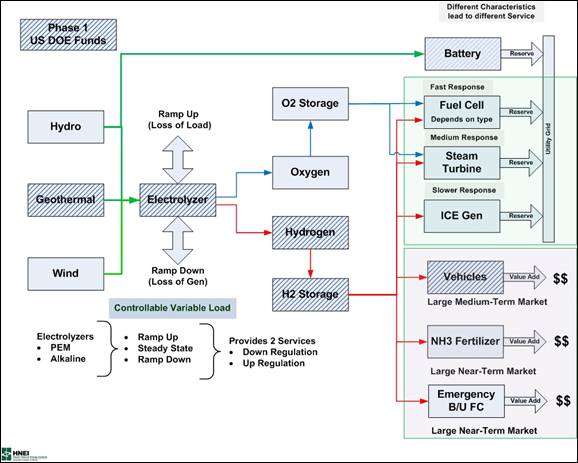
The following figure provides a conceptual illustration of a renewable hydrogen energy system used to produce hydrogen for energy, fuel, and chemical feedstock while also providing grid ancillary services.

Image003

Figure 1: Hydrogen Energy System

The system has three main components.  The first component is an electrolyzer that operates as a controllable load that provides ancillary services to the grid.  A second component, shown in the box on the lower right of the figure, is a set of value added products that utilize hydrogen for transportation fuels and producing fertilizer.  The third main component of the system, shown in the box on the upper right of the diagram, is additional grid services enabled by the hydrogen and oxygen produced by the electrolyzer.  The latter box shows three different potential electricity generating technologies than can used to produce power for additional grid services: fuel cell, steam turbine, and internal combustion engine.

A unique element of the overall program is the demonstration of the electrolyzer as a controllable variable load that can potentially provide grid services such as:

·         Up regulation
·         Down regulation
·         Off peak load (relieving curtailment of as available renewable energy)

In this mode, the electrolyzer would be operated around a production rate that would be determined by the demand for transportation fuels, auxiliary power, and chemical feedstock.  The electrolyzer would have the ability to reduce its load (ramp down) in response to a loss of generation on the system.  This capability to quickly drop load is equivalent to up regulation carried by generating units on the system.  The hydrogen energy system could also provide quick-responding increase in load (ramp up) that would be useful in loss-of-load events, such as a loss of transmission lines.  For this service, the difference between the maximum capacity of the electrolyzer and the steady state defines the ability of the electrolyzer to provide down regulation.