All posts by Richard Ha

Listen To Richard on KIPO-FM Monday 2/1/10

Next Monday’s Energy Futures program on Hawaii Public Radio will focus on sustainable agriculture and its relationship to energy efficiency. Guests will be Richard Ha, president of Hamakua Springs Country Farms located on the slopes of Mauna Kea on the Big Island, and Jerome Renick of the Integrated Agriculture Network, also on the Big Island’s Hamakua Coast.

Energy Futures is broadcast live on Mondays 5-6 pm HST on KIPO-FM (89.3 in Hawaii) and is streamed on the Internet. An archive file of each week’s show is usually posted sometime on Tuesday at the Hawaii Public Radio website.

To listen to this program over the Internet via live streaming audio, click on your player (Windows Media, Real Media or iTunes).

We will be talking on the radio about ag and energy, both subjects that are dear to my heart. Here are some of the things I want to discuss.

Agriculture

For two years now, I have been the only person from Hawai‘i, where we are heavily dependent upon oil for our transportation and for the generation of our electricity, to attend the Peak Oil conference (in Houston 10/07 and Denver 10/09).

The world is not running out of oil – it’s running out of cheap oil. I believe that, in close consultation with the Hawaiian community, we should consider using geothermal for most of the Big Island’s electrical base power needs.

Geothermal breaks even at the equivalent of $57 per barrel oil and will stay steady for centuries. Fossil fuel oil prices will keep on rising, and bio fuels are even more expensive than fossil fuel oil.

We need to choose the alternative that is cheapest and that will not rise in cost, and that is geothermal.

We are busy reorganizing our farm so it will be relevant as oil and gas prices keep on rising. Last summer, when gas prices spiked, some of my workers asked to borrow money to pay for gas to come to work. Clearly, this is not sustainable.

We don’t think that importing foreign labor is sustainable, either. So we are reorganizing into units of small family farms. We call it the “family of farms.” The idea is to utilize our large-scale economy to the benefit of smaller, family-sized units.

For example, we have a local farmer growing all the Japanese cucumbers we used to grow. We provide free water and cooling and they do the farming. We hope to replicate this many times. The result is that all the family farmers will come from the immediate neighborhood, and this way we are not pressured to find workers, nor to provide labor housing.

Energy

I’m big on using Energy Return on Investment (EROI) as another tool to evaluate energy resources.  In the 1930s, to generate 100 barrels of oil took the energy equivalent of 1 barrel. In the 1970s that had declined to approximately 30 to 1, and now it is around 10 to 1. Clearly this trend is not good.

Folks who study these things, Professor Charles Hall in the forefront, estimate that an EROI of 3 to 1 is the minimum for a society to be sustainable. Biofuels, which are often discussed as the solution to the oil problem, have an EROI of <2 to 1.

On the other hand, geothermal has an EROI of 10 to 1 and it will be that way for centuries.

Plus, geothermal is the cheapest form of base power. And because the State owns the mineral rights to geothermal, it is a resource for the Hawaiian people: 20 percent of proceeds from geothermal goes to the Office of Hawaiian Affairs.

In addition, from the “off-peak” stranded power that geothermal provides, we can make ammonia, which can be used as a transportation fuel as well as a fertilizer source.

There’s a lot to like about geothermal.
Kahua Ahupua‘a

The last few days, I’ve been focusing on Kahua Ahupua‘a. Of the three ahupua‘a that comprise Hamakua Springs Country Farms, I find this one the most interesting.

Within 600 feet there are two streams: Makea on the north boundary, and Ali‘a on the south. Between the streams is a ridgeline, maybe 75 to 100 feet from stream level, and running on the ridgeline from mauka to makai is a cane haul road.

It has a clear view of both Mauna Kea and the ocean, as well as of the greenhouses in the valley facing north, toward Honoka’a, and the banana fields facing south, toward Hilo. June and I plan to eventually build a house there. We just submitted a plan to the County in order to subdivide.

Yesterday I spent several hours on the bulldozer, reopening old roads and clearing access to the streams. Today I spent time knocking down many, many 20-foot albizia trees, and making sure the roots were completely pulled out of the ground. There’s one giant albizia tree that is even larger than the ones in this picture. The base is at least 10 feet around and the tree is easily 100 feet tall with many giant side branches. That’s where the seeds for the others are coming from.

I wonder how I’ll get rid of it. Cutting it down is just unimaginable. Here is how they cut a tree down at Lyons Arboretum.

Here is an easier way, with a drill and injecting.

The whole time on the bulldozer, I was thinking about how I can situate some hydroponic hoop houses that would allow us to capture fertilizer runoff, grow algae and raise tilapia. I would get the water further upstream, at a higher elevation, and then run it to the hydroponic hoop houses and use the excess fertilizer to grow algae and then, further downstream, send it to the tilapia. Gravity and free water are our friends.

I am going to grow algae for fuel. Not for cars, but to grow tilapia. Food fuel. The hydroelectric project is close by.

I’m also thinking of making a place to just sit and listen to the stream. I wonder where I can get hapu‘u? Where would kukui nut trees go? Lauhala? Ulu? Hmmm.

This is going to be a big, long project. I’ll write about it as I go along.

Frozen Food

Farmers face many risks. This is something we all have in common.

A couple of weeks ago, Florida farmers experienced temperatures that were 30 degrees below normal.

Here is a slide show of the freeze, from The Packer

 In Belle Glade, Fla., temperatures dropped during the early morning hours Jan. 10 and into Jan. 11, falling to the upper 20s at a time when normal lows are typically 51 to 52 degrees. The result was a freeze that destroyed most of the area’s sweet corn and green bean crops. On Jan. 12, Bryan Biederman, assistant sales manager for Pioneer Growers Co-op, Belle Glade, said losses to crops grown in Palm Beach County will be high. “It appears that we have lost all of our winter corn and winter beans in Belle Glade,” he said. “There may be a planting or two on warmer land that we may be able to save, but for the most part we were completely wiped out in Belle Glade.” Biederman said the corn market shot up to $18 from $12 the week before for wirebound crates of 4-4 1/2 dozen… Read more

Though of course we have other risks here, we are lucky that we don’t have freezes like that. I stood on the farm today, wearing shorts like I do all year long, and in one direction I looked up at Mauna Kea, and in the other direction I could see the ocean.

I thought about how lucky we are to live here in this climate on the Big Island.

Ulupono Organic Farm, First Nations & Geothermal, Korean Natural Farming

There are very interesting things going on all around us right now.

Yesterday, Kimo and I went to Kapalua on Maui to visit with the Ulupono Initiative organic farm folk. They have taken over the organic farm section of Maui Land and Pine and are starting to ramp up the organic farm. I am helping them in their marketing efforts.

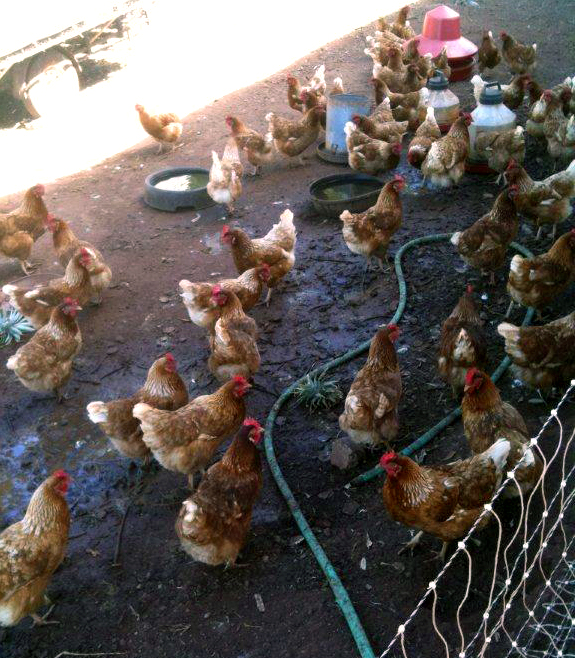
Having grown up on a poultry farm, I couldn’t help myself and I had to take pictures of some of the free-range chickens. They looked happy.

Ulupono Kapalua 007

We flew back to the Big Island and, from the airport, I went straight to a Keaukaha Community Association meeting. Kanoe Wilson, Program Coordinator of the Kipuka Native Hawaiian Student Center at UH Hilo, explained that the Kamehameha Schools First Nations’ Futures Program, of which she is a member, is involved in facilitating dialogue among the various stakeholders surrounding the geothermal issue on the Big Island.

I believe that Kanoe and her group are leading the way in developing a model that shows the proper way to engage the Hawaiian community in future issues. They have a plan to engage the people and then to quantify results.

I am very happy to be working closely with her and the First Nations’ Futures people. It’s a great example of the younger generation taking its future into its own hands. I told the group in a recent get together: “…With their group, the future of Hawai‘i is in good hands.”

I gave a short synopsis of the geothermal resolution that will be introduced by Senator Russell Kokubun on the Senate side and by Representative Mele Carroll, head of the Hawaiian caucus, on the House side. Kanoe and I both emphasized that we were bringing information so the community will be on the leading edge of the discussion. That way decisions come from the bottom up, rather than from the top down.

This morning the Ulupono Initiative/Kapalua organic farm folks came to visit our farm. We are very excited to be on the ground floor of this new enterprise. Ulupono is in the middle of efforts to transition Hawai‘i to a sustainable place. I am happy to be a part of it.

Also, there will be a Korean Natural Farming workshop from February 26th to 28th. This method of farming claims to eliminate much of the fossil fuel inputs of traditional farming, and I feel it has great potential. We are one of the sponsors.

From the brochure:

You will learn a completely sustainable system of farming that requires no off-island inputs and provides abundant and nutritious food. Learn how to:

•    collect and cultivate Indigenous Micro-Organisms
•    make Oriental Herbal Nutrient (OHN), Lactic Acid Bacteria (LAB), Fermented Fruit Juice (FFJ), Fermented Plant Juice (FPJ), Fish Amino Acid (FAA), Water-Soluble Calcium (WCA), and Water-Soluble Calcium Phosphate
•    These ingredients enhance plant growth and you will learn how to apply these inputs in synchronization with the nutritive life cycle of plants.

Gail Tverberg & Peak Oil

Gail Tverberg wrote this article for Oil and Gas magazine:

It seems to me that the current recession is very much energy-related, and is likely to continue. The recession is occurring because the current US “system” (individual homes, private cars, many imports) was built for cheap ($20 barrel) oil and gas, and cannot function well using expensive oil and gas.

She notes that people’s income are relatively fixed and any increase in energy costs is not good for the economy. This means that expensive energy will hurt us, while cheaper energy will help us. If people no more money, they cannot go to the stores.

Geothermal gives us a way out.

When energy matters came to my attention several years ago, Gail’s writings stood out. They are clear, simple and easy to understand. Gail has a mathematical background. She worked as an actuary, advising the insurance industry on risk and reward matters.

Later, I found out that most Peak Oil staffers are international and nationally recognized experts in the oil and gas industry, or experts in other relevant fields. They know what they are talking about. I respect simple competency.

When I went to the first Association for the Study of Peak Oil conference in October 2007, in Houston, I made sure to go up and introduce myself to Gail.

As soon as I came back, I suggested to Betsy Cole of the Kohala Center that they do an energy conference. It took place in June 2007 at the Hilo Hawaiian, and Gail was the featured speaker.

After the conference I spent three days taking Gail and her family sightseeing. Peak Oil was on both of our minds and we spent quite a bit of the time talking about the ramifications.

Although masked by the present recession, the same forces of declining oil supplies are still at work two and a half years later. Many folks from Hawai‘i responded to her post on the Big Island. It is true that we are very much aware of what is going on.

Back then I called Kale Gumapac, alaka‘i of the Kanaka Council, and told him that I could arrange for the Kanaka Council to hear Gail’s talk free of charge. He told me that his people would feel awkward among the “shiny shoe” crowd*.

So instead I made arrangements for Gail to see them at the Lili‘uokalani Children’s Center. Though the Kanaka Council members were at an important County Council hearing, they all went over to hear Gail speak.

It was remarkable how Gail’s message resonated. For them, it was not a matter of “if the boat not going come.” It was a matter of when.

During the talk and after, they  treated Gail as a kupuna. It was remarkable to see.

* This is where the phrase “rubbah slippah crowd” came from.

More Thoughts on Peak Oil – And Our Solution

I thought that I would revisit a post I did on my first impressions of the Peak Oil conference in Denver this past October. I have added comments to the post I did back then. My new comments are in italics.

Examining Energy Alternatives

I learned something interesting at the Peak Oil Conference I’m currently attending in Denver. It’s about a pattern. When U.S. oil costs exceed four percent of the gross domestic product – so, when the price of oil hits $80 per barrel – we go into recession. (Note that this does not mean oil prices won’t go even higher than $80 per barrel.)

I think that investors are very reluctant to bet against the pattern above. They know that at some point above 4 percent GDP, they will be playing with fire. Last July’s oil price of $147 and the immediate collapse is fresh in their memories as something that can happen. So we watch as the stock market and oil prices twist themselves into a pretzel, according to the strength of the U.S. dollar, the strength of the Chinese economy, the cold winter, the status of Iraq, the riots in Iran, and on and on.

We should be paying attention to the actual supply situation. The natural decline rate of the oil supply is between 5 and 6 percent. That means we need to find 4.5 million gallons per day of new oil supplies — every year — or we are going to be short.

Right now, we have more than enough oil. But Jeff Rubin, former chief economist of CIBC, predicts $225 per barrel oil by 2012 and with it the end of globalization, a movement towards local sourcing and a need for massive scaling up of energy efficiency.

We need to move to geothermal now, not thirty years from now.

David Murphy talked about Energy Return on Investment (EROI), and I asked him what he thought the EROI is for geothermal. He said around 10 to 1, and he agreed with me that it is an attractive alternative energy to pursue for Hawai‘i. This was the consensus of everyone I asked about geothermal. Because geothermal costs are stable, it’s a no-brainer.

Terry Backer, a panel member and long-time Connecticut legislator, pointed out how he sees the economy unwinding. He said that people in his state had been doing okay. In early 2007, although things were tight, people had around a $400-500 per month cushion. But then the price of heating oil was high in the winter, and then the price of gas went to $4.50 per gallon, and food prices went up too. It just stripped people of their “cushion.”

If the consumers have no extra money they cannot buy things. Elizabeth Warren gave this speech that says it all. (Coincidentally her base year is 1970, the year that oil peaked in the U.S.).

The question is, how do we give the middle class disposable income? Choosing the low cost alternative to fossil fuel can help. We have geothermal, which is this.

It’s exactly why we need to move to geothermal. It will stabilize costs, and protect folks forever from ever-higher electricity and water bills that result from rising oil prices.

We need to force that change, not give a thousand reasons why “no can.” Sure we can try other alternatives. But as farmers always say: “What works, works.” Geothermal works.

We must be careful not to end up like Iceland. Fishing and geothermal worked. But instead they started chasing after finance matters, whose foundation rested on sand. Their economy collapsed and now they are left with fishing and geothermal—the things that still work.

And when people start buying electric vehicles, this will protect them from gasoline costs, too. As for businesses, their customers will have more discretionary income to spend. The government will see fewer folks fall through the cracks.

We probably are going to be dependent on gasoline for transportation for a long time. One practical way for Hawai‘i people to protect themselves from high gasoline costs is to buy hybrid vehicles. In Japan, hybrids are a hit. On the Big Island, the more “base power” that comes from geothermal, the more discretionary income people will have. The more discretionary income people have, the more business prospers and the more jobs are available for people who are raising their families.

In the final analysis it is about the consumers. Consumers drive the economy. We tend to forget that.

For native Hawaiians, the use of the geothermal resource will generate revenues in royalties and possibly rents as well. They are consumers, too.

Biofuels, on the other hand, are not expected to be cheaper than oil, and may even need subsidies from consumers. Why would we do that, when we can instead save consumers money by using geothermal?

By now, everyone must be aware that biofuels are wishing and hoping. We wish it would work. Farmers know that it will be very expensive and that it will take money away from consumers.

We need to put in a cable to O‘ahu. They need base/dispatchable power over there, on top of which they can put solar and wind. Without that, O‘ahu will be hopelessly dependent on oil.

All that is true. But we need to take care of the people on the Big Island before we even consider another option. That point was made abundantly clear at a presentation on geothermal I did for the Keaukaha Community Association.  Done right, with community input and community benefit, I’m confident that the people would look favorably on sending power to O‘ahu. But it is a Big Island discussion.

As a farmer, I am concerned about where we are going to get the fertilizer to feed ourselves. Nitrogen, the building block of protein, is extracted from air using high heat and pressure. Oil and gas are what is used now, and that process takes lots of power. But if oil and gas prices rise enough, geothermal power can be substituted. We need to place ourselves in a position to win.

Again, geothermal would generate a lot of royalty money for the Hawaiian people. Without this revenue source, we will see more and more cuts to social services.

I am very encouraged to see that Hawaiians are leading this discussion. This is the right thing to happen.

Geothermal can be a blessing for the Hawaiian people.

If we can maximize its use as a resource for the native Hawaiian people, we will also strengthen our middle class. If we do that our businesses will flourish, everybody will benefit and our future will be hopeful

2009 Was A Bad Year For Biofuels

Last month, I wrote that instead of a 20 cents/pound subsidy for
biofuels, I would rather see a 20 cents/pound subsidy go to
farmers.

Soybus

2009 was a very tough year for biodiesel. Robert Rapier wrote, at The Oil Drum: “The wheels came off the biodiesel wagon.”

How disastrous was 2009?

Per the National Biodiesel Board (NBB), here are the statistics from the past 6 years of biodiesel production:

2004: 25 million gallons
2005: 75 million gallons
2006: 250 million gallons
2007: 450 million gallons
2008: 700 million gallons
2009: 300-350 million gallons (estimate)

The NBB also reports that domestic biodiesel capacity is now operating at only 15%. There have been a number of stories in the past few days covering these developments.

That’s a bad start to 2010, after a “rough year” for the entire biofuel industry.

Whale/Rider

Serrell Kanuha is my very good friend Duane’s brother. He was our postman for awhile, and would frequently stop and talk story.

Serrell does things in a big way. After retiring from the Post Office he took up mountain biking, and he would tell his brother Duane to drop him off at the Saddle Road side of Mana Road and pick him up later at Waimea.

My son Brian told me that Serrell was one of the Ninja motorcycle riders that all the young guys respected and looked up to. His legs are all shot up from Vietnam but that is no obstacle.

I’m not surprised he is now out on the ocean. Serrell and Duane’s Kanuha ancestor was in the first wave of canoes that came up from the south Pacific.

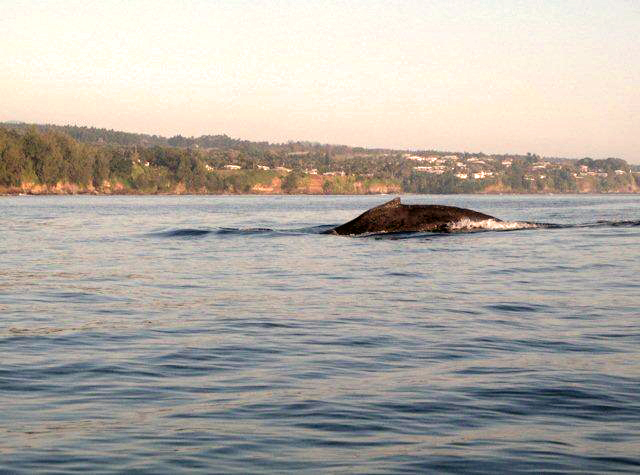
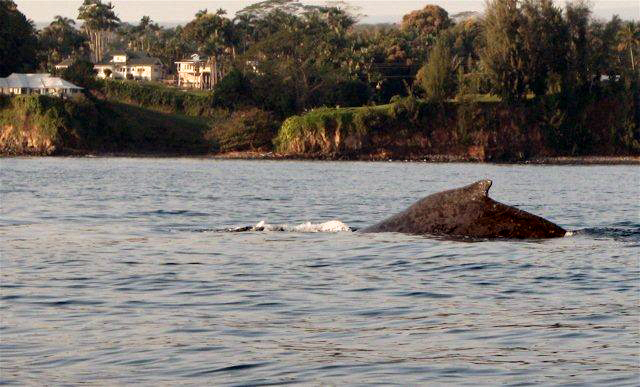
He’s into stand-up paddle surfing now. Recently while he was out off Honoli‘i, he was as close as 30 feet from four or five whales, plus a baby.

IMG_0650_9

He said they would all be heading in one direction on the surface and make you think they would pop up further along in that same direction. Instead they would do just the opposite.

On the left side of this picture, just outside of the frame, is Bay Shore Towers.

IMG_0651_10

Study: U.S. Should Reconsider Biofuel Policy

Now there’s a study out saying it is basically wrong to pursue our present biofuel policy. I agree with it completely.

In the 1930s, you could get 100 barrels of oil with the energy from one barrel. In the 1970s, this had decreased to 30 to 1. Now, oil’s Energy Return on Investment (EROI) ratio has decreased to 10 to 1, and it will steadily decline as oil is more and more difficult to harvest.

To sustain our society, we must have an EROI of at least 3 to 1. Biofuels only have an EROI of 2 to 1.

Geothermal, however, is 10 to 1, and that ratio will stay steady for centuries.

Rice University’s Baker Institute for Public Policy took a strong stance in the following article, and it goes against everything that is taking place in Hawai‘i today. Lots of the biofuel companies are benefitting from the new stimulus money, which is pushing biofuels that have ex-HEI folks in their organizations.

HOUSTON (Dow Jones)–The U.S. government needs to rethink promoting ethanol as a way to enhance energy security as production of the fuel is costly for taxpayers and poses economic and environmental risks, according to a study released Wednesday.

The report by the Rice University’s Baker Institute for Public Policy notes that in 2008 the U.S. government spent $4 billion in biofuel subsidies to replace 2% of the U.S. gasoline supply. The average cost to the taxpayer of those substituted barrels of gasoline was roughly $82 a barrel, or $1.95 per gallon on top of the retail gasoline price, according to the study.

“We need to set realistic targets for ethanol in the United States instead of just throwing taxpayer money out the window,” said Amy Myers Jaffe, a senior fellow in energy studies at the Baker Institute and one of the report’s authors.

Here are the names of leaders in the Baker Institute for Public Policy. I especially trust Colin Powell, who seems balanced and credible to me.

Personnel
•    James A. Baker, III Honorary Chair,
•    Edward P. Djerejian, Director (former American Ambassador to Israel and Syria and Assistant Secretary of State for Near Eastern Affairs).

Board of Advisors
•    William Barnett
•    David Leebron
•    Colin Powell
•    Madeline K. Albright

New Tomato Virus

Back in November, I received this note from Dr. John Hu (who is a plant pathologist at the University of Hawai‘i’s College of Tropical Agriculture and Human Resources). It said they had found a new tomato virus on Maui — one that is considered the most devastating tomato virus worldwide.

This virus is not spread by seed or by mechanical means, but by the white fly. So if it is only spread by the white fly, how did it get to Hawai‘i?

It’s possible it was by infected white flies hitchhiking on vegetables imported from the mainland. As usual, farmers will pay the price for this disease. The true cost of importing fruits and vegetables to Hawai‘i is much more than what one pays at the supermarket.

Dear Richard:

Recently, we have found a “new” virus from tomato samples in Maui.

As far as I know, this is the most devastating tomato virus worldwide! It has been reported in many other countries including the mainland USA.  However, this is the first time we have seen it in Hawaii. Potentially, it could be a very significant problem for you and the entire tomato industry in Hawaii.  Plus, we may have similar viruses in other vegetable crops in Hawaii.

Please see the attached two files for the background information regarding the virus, the impact, and potential management options.

I have talked to Dr. C.Y. Hu and Dr. P. Lai, who is in charge of our T-STAR program in CTAHR.

Both of them are very concerned about this new potential problem for our tomato growers and are very much in support to work on it!

Read more about the disease here:

Tomato Yellow Leaf Curl 1

Tomato Yellow Leaf Curl 2

Tomato Yellow Leaf Curl 3

At the farm we will scout specifically for plants with these types of symptoms. But we are very worried that this disease will come to the Big Island. The history of invasive species makes it likely that this disease will get here.