All posts by Richard Ha

TMT & Money For Our Children’s Education

Nine months into discussions about what will be important to our community if the Thirty-Meter Telescope (TMT) comes to the Big Island, I feel that we can get at least $100 million for the education of our children over the next 50 years. At a minimum; it could be more.

Last summer, I wrote a post speculating about how the TMT could benefit our island if it were built here on Mauna Kea. I wrote:

I’m on the board of the Hawai’i Island Economic Development Board, and we’ve made it clear that this can only happen if, unlike with previous telescopes, our people clearly benefit from it.

That post last August had a lot of “What ifs,” regarding how our people could benefit from the siting of this telescope here, as opposed to what’s happened with past and current telescopes.

We have made a lot of progress. It’s pretty amazing how far we’ve come, and how many of those “What Ifs” have been addressed.

In their draft Environmental Impact Statement (EIS), the TMT people have committed to a community benefit package as well as a higher education package. I wrote last week, before the draft EIS was published, that the community benefit package will consist of at least $1 million dollars annually for the education of our keiki.

The higher education package will even surpass the community benefit package.

This means that the TMT will be giving at least $2 million per year, over the next 50 years, for the education of our Big Island children. That’s for both kids in K-12 ($1 million/year) and those in higher education (Hawai’i Community College and the University of Hawai’i at Hilo; $1 million/year).

Two million dollars for education every year for the next 50 years. At least $100 million over the next 50 years.

It’s a far, far cry from the $1/year rent that telescopes pay now.

The money for younger kids is to help kids so they are in a position to succeed when they are in high school-that is the whole objective. It takes smart people to do that; educators, not us. We’re just putting in the framework so the smart people can figure out how to do that in these times. The money would be administered through a foundation by seven people, chosen geographically from around the island. Programs will apply for grants.

From my post last August:

• What if the TMT coming here meant disadvantaged Hawaiian (and other race) students can attend Hawai’i Community College and the University of Hawai’i at Hilo for free?

That discussion is going on right now. People are looking at the “unmet needs” of these students.

• What if we develop a pathway for local people to fill jobs during the extensive construction and operating of the telescope?

The TMT’s Environmental Impact Statement addresses work force development. They are looking at developing the skills of today’s ninth graders, so they will be ready to step into jobs that open up when the TMT is built eight years from now.

• What if we collect all the funds attributable to astronomy and have that money administered by a group of wise people who are chosen specifically to allocate it to the education of this island’s keiki?

The Hawaii Island Economic Development Board set up the framework and governance of this fund specifically for the education of our keiki, emphasizing K-12. It will be administered by the Hawaii Community Foundation.

• What if these credible people fund education programs about the Hawaiian culture and Hawaiian language, and about traditional ways of sustainability, the sciences, job skills and other subjects that prepare our children for a new world where we, living on the island of Hawai’i, might have to survive on what exists here on our island?

We recognize that not all students are suited for a career in astronomy. A certain percentage of this fund is set aside for Hawaiian cultural and traditional approaches.

• And what if this organization exists far into the future and benefits many generations to come?

An annual contribution will ensure this. In addition, wise administration of these funds will ensure benefit to future generations.

• What if, not at the summit though on Mauna Kea, the world’s finest and most powerful telescope looks back in time to the beginning, seeking the answer to the question, “Are we alone?”…

If the TMT helps our people to help their keiki succeed, our people will help the TMT succeed.

…while on the ground, the people have learned how to restore the ancient fish ponds, and are supplementing that with modern aquaculture methods that don’t require oil? And the people on the island’s windward side are using their abundant water to again grow kalo, and growing food with hydroponics, and as in pre-Western times they are able to feed everybody without depending on foreign oil?

A rising tide raises all boats.

It would be the best of the future and the best of the past. What if?

We have some answers to our What Ifs now, and they are pretty impressive.
Mauna Kea: The Beginning of “Doing It Right”

The Thirty Meter Telescope project is getting ready to submit its draft EIS.

When I volunteered for the Thirty Meter Telescope committee of the Hawaii Island Economic Development Board nearly three years ago, I said: “If the TMT is to come here, we need to do it right.”

There needed to be big changes:

  • We needed to make sure that the mountain was under the control of the University of Hawai‘i at Hilo. Mauna Kea is the kuleana of Big Islanders, and this was an important change. It happened. A rule making bill passed through the legislature, which gave the University of Hawai‘i at Hilo enforcement powers to protect the mountain.
  • We agreed with Judge Hara that a Comprehensive Management Plan (CMP) needed to be done. The CMP has been done.
  • We’ve said from the start that $1/year rent is not acceptable anymore. Instead of $50 for 50 years, let’s start at $1 million/year, which would be $50 million for the education of our keiki from kindergarden to 12th grade.

As I said nearly three years ago: “If the TMT is to come here, we need to do it right.”

This is the beginning of doing it right.

‘Amounting to Something’

I recently read a nice article in West Hawaii Today of a young person, Mike Rasay, who came out of a small rural school in South Kona.

The 1997 Konawaena graduate idolized our Kona-born and -raised astronaut Ellison Onizuka, and is now doing things he could not have imagined just a few years ago — such as serving as a “ground segment lead in Tuesday’s launch of a NASA microsatellite to study space’s affect on cells in long-duration space travel.”

These are the kinds of things that happen when students are influenced by a special teacher, inspired by surrounding events and supported as they pursue their dreams.

All Big Island students now go on excursions to ‘Imiloa Astronomy Center, where they are awed and inspired by stories of astronomy and Hawaiian culture. If the Thirty Meter Telescope, the best telescope in the whole world, comes here with a new paradigm of support for local communities and education for young students, more people like Mike Rasay will find themselves being able to do the unimaginable.

Rocket science: Konawaena grad contributing to NASA mission

by Chelsea Jensen
West Hawaii Today
cjensen@westhawaiitoday.com
Monday, May 4, 2009 8:55 AM HST

Never let graduating from a school in Hawaii keep you from accomplishing your dreams.

“I have been on the bad end of the comments where people say ‘you’re never going to amount to anything. You’re never going to have a chance to do anything you want to so there’s no sense in trying,'” said Mike Rasay, a 1997 graduate of Konawaena High School who will serve as a ground segment lead in Tuesday’s launch of a NASA microsatellite to study space’s affect on cells in long-duration space travel.

“I never thought I would get into doing space missions. You never really think it’s possible,” said Rasay. “I always feel like I proved the naysayers wrong and just have been able to break through all of the negative generalizations about the students from Hawaii.”

Read the rest of the article at West Hawaii Today.

Make Farms and Farmers Cool Again

My friend Jeff Alvord sent me this link to a Michael Pollan talk called “Deep Agriculture” on the blog The Long Now. Jeff Alvord is a key employee working for Pam and Pierre Omidyar, who are major supporters of the “The Long Now,” a long-term, thinking blog.

It is absolutely true that agriculture is tied closely to oil. As Pollan says, we are eating cheap oil.

The opening of this article:

Farming has become an occupation and cultural force of the past. Michael Pollan’s talk promoted the premise — and hope — that farming can become an occupation and force of the future. In the past century American farmers were given the assignment to produce lots of calories cheaply, and they did. They became the most productive humans on earth. A single farmer in Iowa could feed 150 of his neighbors. That is a true modern miracle. “American farmers are incredibly inventive, innovative, and accomplished. They can do whatever we ask them, we just need to give them a new set of requirements.”

Part 3: We Have Two Good Options

In Part 1 and Part 2 of this article, we talked about how in just one generation, the U.S. middle class increasingly came under financial pressure. And we talked about how our whole complex economy is now resting on the stressed-out middle class.

We are noticing that as the finite oil supply depletes, the world population increases, and that puts more and more pressure on demand. As prices rise beyond what we can stand, our economy will drop back into recession. It’s a scenario that can keep repeating itself.

There are a couple of “big picture” things that are unique to us living here on the Big Island, which we can use to do something about all this.

1) We can support the Thirty-Meter Telescope (TMT). Now that the Comprehensive Management Plan has passed, there are specifics in place to take care of Mauna Kea and so we can proceed with the Thirty-Meter Telescope process.

The TMT is a $1.3 billion construction project. It will take nine years to build and will employ more than 300 people during the construction phase. These jobs will help alleviate pressure on our middle class.

Many people feel that most oil exporting nations will no longer be able to export oil within 10 -20 years. If so, we will be happy to have a resource like the TMT located on the Big Island.

In steady state operation, the TMT’s payroll will exceed $25 million a year — and it will be around for 50 years after construction is finished in nine years or so. These are steady jobs that will not rise and fall with the economic times. This will be increasingly more important as the economy suffers from rising oil prices.  In addition, the TMT folks are willing to dedicate a significant amount of money to the education of our keiki, K-12 and beyond.

In addition, the TMT folks are willing to dedicate a significant amount of money to the education of our keiki, K-12 and beyond.

Having this opportunity to site the best telescope in the world on our island is a unique opportunity that comes only once in a lifetime. For the sake of the future generations here, we need to make it happen.

2. The other opportunity unique to the Big Island is the possibility of increasing use of geothermal energy as a source of generating electrical power. Geothermal energy is very dependable and steady. It’s the most dependable source of renewable energy we have available on the Big Island. Let’s use more of it, now!

Our electrical utility HELCO is tasked with providing us dependable and inexpensive electrical power. They also have an obligation to give their investors a fair rate of return. They have a two-part problem.

Electricity usage decreases with lower economic activity, yet they need more electricity sales to generate income for their investors. How about increasing the use of electric vehicles to increase sales for HELCO? Simultaneously, we can utilize as much geothermal energy as possible to stabilize the cost of electricity and make our electric grid more dependable.

It takes energy to get energy. The energy left over, after we use some to grow our food, gives us our lifestyle. We in Hawaii can look forward to a good lifestyle if we switch to renewable sources for our energy. And geothermal gives us the best opportunity to maximize all the renewable resources we have available to us.

By supporting the TMT and Geothermal Energy here, we could have good jobs, good education and dependable, reasonably priced energy. As we face an uncertain future, this would not be such a bad outcome!

Part 2: How Will We Address This?

Did you read Part 1, The Coming Collapse of the Middle Class? That tells an interesting story of what’s happened to the middle class since the 1970s, and how much harder it is for people to keep up now.

With that background in mind, I think the price of oil rising to $147 per barrel was the straw that broke the camel’s back.

Once that happened, some folks could no longer make their house payments, and from there everything started to come apart. People blamed the greedy bankers, hedge fund people, the slicing and dicing of credit instruments, etc. And to a large extent that was true.

But the people on the bottom of the pyramid, the middle class, were already stretched too thin. They had no place to turn. So foreclosures started.

Here in Hawai‘i, we have many of the same problems as the nation as a whole. But, to their credit, our banking institutions stuck to the old-fashioned requirement of qualifying lenders to make sure they could make payments before they lent money. Had they not done that, it would have been much worse.

Now we have to figure out what we are going to do to help our people, and to make Hawai‘i a place our children and grandchildren will be able to afford when they grow up.

The most important consideration is that we depend on oil here for most of our power. We know that we need to get off foreign oil.

Electric cars are an idea that do seem feasible here in Hawai‘i, and we think they will work.

Another idea that keeps being discussed, and one that concerns me, is replacing fossil fuel oil with biofuels. Several years ago, a bunch of us farmers sat in a meeting where biofuels were discussed as a possible new crop for Hawaii’s farmers.

We were told that palm nuts could generate x amount of production per acre and that jatropha could generate x amount of production per acre. We knew these were a soft answer at best.

I believe that oil was close to $100 per barrel then. We did this simple, back-of-the-napkin calculation:

If oil was $100 per barrel, this equals 35 cents per pound. We farmers made a quick calculation: What if it took four pound of stuff (palm nuts, jatropha, kukui nits, whatever) to squeeze out one pound of oil. At $100 per barrel oil, no farmer in his right mind would grow biofuels to get 9 cents/pound for their crop. At $200 per barrel for oil, the farmer would only get 18 cents per pound.

The conclusion then is that by growing jatropha, kukui nut, macadamia nut and palm nuts for biofuel, farmers lose money. No farmer would grow these crops for these returns!

How about the second generation cellulosic biofuels? A couple of things bubble up. They can be produced for $10 – $20/gallon. But the required volume throughput needs to be huge, and the plantings need to be close to the refinery to be efficient.

The Hamakua Coast is very hilly and its high rainfall took a toll on sugar companies; that’s why sugar went out on the Big Island. The location was just not competitive relative to other places in the state of Hawai‘i.

As much as we want to get a liquid biofuel source, we do not think it will work in the long run. Biofuels are not the answer.

Stay tuned for Part 3, where we’ll discuss what the answer might actually be.

“The Coming Collapse of the Middle Class”

Here is a very interesting video that talks about the incredible changes that have taken place in American in only one generation.

It’s called “The Coming Collapse of the Middle Class: Higher Risks, Lower Rewards, and a Shrinking Safety Net,” and it’s a talk by distinguished law scholar Elizabeth Warren, who teaches contract law, bankruptcy, and commercial law at Harvard Law School.

She is an outspoken critic of America’s credit economy, which she has linked to the continuing rise in bankruptcy among the middle-class.

Her talk covers much more than that, though. [Editor Leslie’s note: I just sat and watched that entire one-hour video, practically without blinking. I didn’t have time to, but it is fascinating and I watched it all the way to the end. I highly recommend it.]

Some of her points: In the 1970s, a married couple with two kids had one parent in the workforce and saved 11 percent of their income. To get into the middle class, their kids needed to get a high school diploma and to be willing to work hard. That 12 years of education that their children needed, to get into the middle class, was free.

Warren says that the most important thing that happened in the first two-thirds of the 20th century was that women entered the work force.

In the 2000’s, a similar married couple with two kids must have two people in the work force – because, she says using numbers adjusted for inflation, median mortgage payments in 2005 are 76 percent higher than they were in 1970. Health insurance – in a healthy family with employee-sponsored health insurance – costs the family 74 percent more. Childcare costs have increased 100 percent, and as compared to the 1970s family a 2000s family has the expense of a second car because of that second person in the workforce, and because of that second income their tax rate is up by 25 percent.

In comparable dollars, the 2005 family is actually spending much less on clothes, food, appliances and cars than the 1970s family did; it’s the non-flexible, big ticket and important expenses that have increased so dramatically and that require that second income.

So a comparable married couple with two kids in 2005 has no savings (compared to the 1970s couple, who saved 11 percent of their earnings), and 15 percent of their income is in credit card debt as they try to keep up.

To launch their kids into the middle class requires 16 years of schooling, and the 2005 family has to pay  for the first two years (preschool) and the last four years (college) themselves.

She also discusses how, compared to the 1970s, hospitals now send people home “quicker and sicker” (their phrase, she says) in order to control costs, and the family is shown how to and expected to care for, say, a post-surgery patient themselves. Which generally requires someone taking time off work.

And there is so much more on that video. It is a real eye-opener.

So today’s middle class is under terrific debt pressure. I think the effect is called a lower marginal propensity to consume. They get too many bills!

How is this related to the economy in general?

Gail Tverberg writes that a multiplicity of debt rests on a small base personal income. She writes: “It looks to me as though we are due for a debt unwind, and with it a rapid decline in the U.S. standard of living. Exactly what form it will take, and what the timing will be (for example, sudden one month from now or sudden three years from now, or gradual over a longer period), isn’t certain. I would expect that many (or most) other economies in the world will be dragged along in this debt unwind and will experience a decline in their standards of living.”

If Elizabeth Warren and Gail Tverberg are right, then it appears that an external shock to personal income would cause a ripple effect throughout the economy. Could this latest shock have been caused by the demand of a growing population pushing up against a finite resource, such as oil?

If so, we are facing an economic future of highs and lows where the lows become increasingly deeper and longer. We cannot afford to wait; we need to pay attention to the basics – food and energy!

We need to plan for the worse and hope for the best. We must utilize every advantage available to us as we transition away from imported energy.

It is not about us anymore – now it is about future generations.

We’ve been hearing that the American consumer is under pressure and that our economic system is a house of cards. Will Peak Oil come to be the straw that broke the camels back? Because of the resources we have available to us, I think that we in Hawai‘i have a very good future if we focus our attention on future generations.

There is a reason I am talking about all this right now. Check back here on Monday and I’ll tell you about Part 2.

Hawai‘i to Become a “Better Place”

Do you know about Better Place coming to Hawai‘i?

Better Place is working to build an electric car network, using technology available today. Our goals? Sustainable transportation, global energy independence and freedom from oil.

Shai Agassi is founder and CEO of Better Place, and in the following video he talks about his mission. His company has a plan to take entire countries oil-free by 2020.

From ted.com: Agassi stunned the software industry in 2007 by  resigning from SAP to focus on his vision for breaking the world’s fossil-fuel habit, a cause he had championed since his fuse was lit at a Young Global Leaders conference in 2005. Through his enthusiastic persistence, Agassi’s startup Better Place has signed up some impressive partners — including Nissan-Renault and the countries
of Israel and Denmark.

Electric vehicles for our transportation needs are starting to come into focus. Better Place has announced that it is partnering with Hawai‘i to make mass adoption of electric vehicles powered by renewable energy a reality in the state by 2012.

From Better Place:

The state’s partnership with Better Place will play a significant role in the economic growth of Hawaii and will serve as a model for the rest of the U.S. for how green technology infrastructure can fuel job creation. The implementation of electric infrastructure will reignite the Hawaii economy with local jobs, while creating a model for renewable energy growth. It will also expose the millions of annual visitors to Hawaii to the real possibilities of life with clean energy and renewable fuel.

A bill currently going through the Hawai‘i State Legislature will require that large parking facilities have charging stations for electric vehicles.

People are even developing heavy transportation electric vehicles.

Why is Hamakua Springs Country Farms interested in electric cars?

It’s because we are building a hydroelectric plant, where we will generate electricity from water that runs through a flume on our property. We will sell the excess electricity back to the public utility.

We wonder how farmers everywhere in Hawai‘i can participate in renewable energy production.

Oil is a finite resource and world population is increasing at the rate of 70 million annually. We all know that oil prices will rise to unbearable heights in the future.

We also know that our food security depends on Hawai‘i’s farmers farming, and making enough money that they stay in farming. How can we position our farmers so they make money on renewable energy they generate on their farm, in addition to the money they make farming? Because we know that if the farmers make money, the farmers will farm.

Renewable energy production is capital-intensive, not labor-intensive. There is no weeding, spraying, plowing or harvesting. Once a renewable energy project is installed, the farmer can go back to farming.

In conjunction with this need for food security, I suggested to the Farm Bureau that we initiate a bill that would authorize preferential rates of return for bonafide farmers who produce renewable energy. HB 591 HD1 SD2 is likely to be passed by the Legislature this session.

If the farmers make money, the farmers will farm. And then we will have food security.

Green Point Nurseries at Kino‘ole Farmers Market

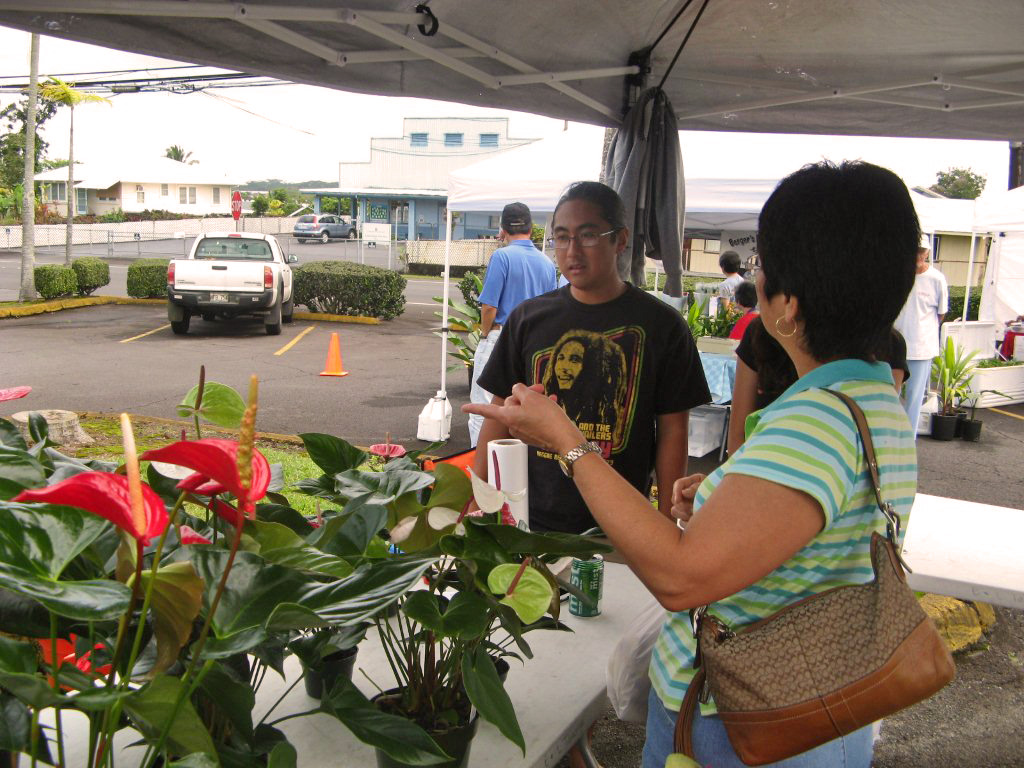
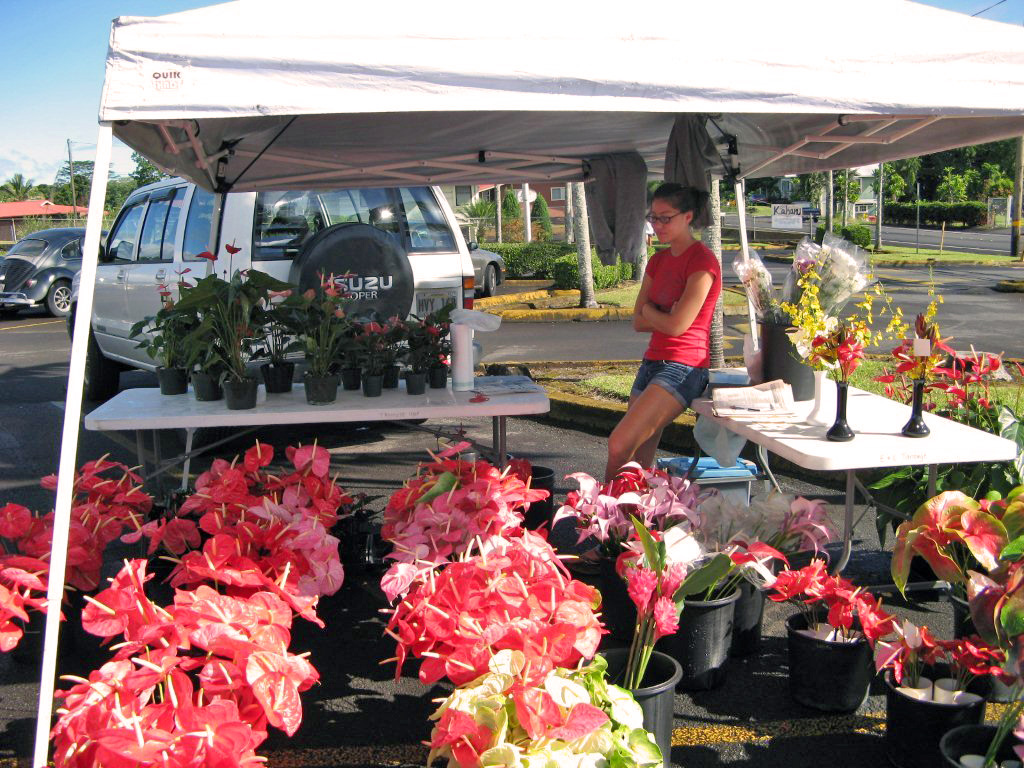
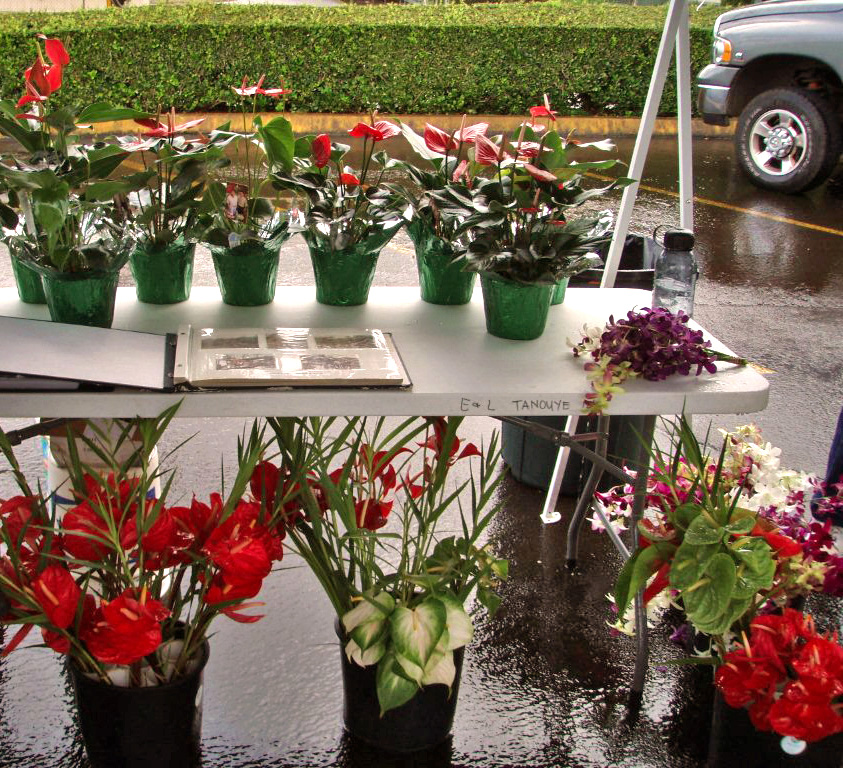
One of the companies you’ll find at the Kino‘ole Farmers Market on Saturday mornings is Green Point Nurseries. The family-run business is usually represented at the market by John Tanouye, son of the company’s Eric Tanouye and grandson of founder Harold Tanouye.

Harold Tanouye started the nursery business in the late 1950s, when he returned home to Hawai‘i after having been at college on the mainland. Growing anthuriums in Hilo was only a part-time, backyard-type cottage industry then. Now, half a century later, Green Point Nurseries is a very successful commercial operation known for its innovation, customer service and work toward sustainability.

And also its beautiful anthuriums, of course.

Kinoole farmers market 032

Kinoole farmers market 2 030
John Tanouye with a customer

Kinoole farmers market 019
John’s friend, with Green Point Nurseries anthuriums

UH Board of Regents Accepts Responsibility for Mauna Kea CMP

On Friday, the University of Hawai‘i Board of Regents officially accepted the responsibility of implementing the Comprehensive Management Plan for taking care of Mauna Kea. They also appointed two Regents to sit ex-officio on the Mauna Kea Management Board. This is great news for those who want to be assured that management of Mauna Kea be done on the local level.

And in the legislature, conferees from the House and the Senate, who will reconcile HB 1174, HD3 SD2, the rule making bill that enables the Comprehensive Management Plan, have been set. The conferees all voted “aye” to the bill with large majorities when it passed through their respective Houses. The final bill was not very different from the ones that passed through both chambers and there should not be much difficulty reconciling the differences.

This is a good example of what it means to “follow the process.” There were no shortcuts or end arounds. Everyone had a chance to speak their mind and in the end, it made for a better document. Congratulations all!