
All posts by Richard Ha

We Are Confident In Our Food Safety Procedures

Someone reports finding a slug on lettuce he bought that had our label on it. He says he bought it on Sunday at the Pahoa Farmers Market.

But we do not sell our lettuce at the Pahoa Farmers Market, and do not have vendors selling our product at any Farmers Markets. Apparently, and unknown to us, someone must have bought our lettuce and resold it. We did not have control over that lettuce. It could have been contaminated when out of our control. It’s also possible someone packed other lettuce into our container/label. There’s no way to know.

We only sell our products at Farmers Markets ourselves. If you see our product at a Farmers Market, come up and say hi. We’ll say hi and introduce ourselves, and you’ll be talking to me and/or members of my family.

For many years now we have been very proactive about slugs and slug-borne diseases. I have written about this here before.

We do not grow our lettuce in dirt. Instead, we grow our lettuce on floating rafts. The lettuce roots gets their nutrients straight from the water. This helps us to maintain a barrier from slugs.

We were the first company in the state to be third-party Food Safety Certified. We could have been satisfied with that, and just relied on our food safety certification (which is voluntary, and adds a lot of labor and cost to our operation, but is important to us). But we are serious about doing everything we can to protect our customers, so we took it one step further.

Although there haven’t been any cases of the slug-borne “rat lungworm disease” reported in Pepe‘ekeo, where our farm is located, we voluntarily instituted a program to cut the potential lifecycle of the rat lungworm (the carrier of the rat lungworm disease).

Because the disease lifecycle requires the rat lungworm to live part of its life in a slug and part in a rat, we developed a program of slug baiting and rat baiting/trapping to make sure that the cycle was cut. So on our farm, even if a slug got by us, the chance of it being infested with the disease is unlikely.

We sympathize with the person who found a slug, but we have carefully doublechecked our procedures and are confident they are working as planned.

I don’t blame him for feeling frustrated. But the world is changing and we need to be thinking of how we will help each other face the uncertain future together. We need to make strornger communities, we need to make more friends and we need to stay closer to our families. In an uncertain future, it will be the aloha spirit that will help us cope with an uncertain tomorrow.

‘Crazy Economics’ of Oil/Gasoline Explained By Howard Dicus

Oil pricing is affected by many factors, but it’s important to be mindful of long term trends. Such as what I keep reminding you of here: That for the last 20-30 years, the world has been using twice as much oil as it has been finding. Just to keep up with the normal oil decline rate, we would need to find a Saudi Arabia every two-and-a-half years.

Hawaii News Now writer Howard Dicus wrote a very informative blog piece, about what causes oil prices to rise and fall, called The Crazy Economics of Crude Oil and Gasoline

The price of crude oil crashed today for reasons so complex and crazy it will surely reinforce your view that mankind has invented markets too complicated to manage.

…As a regular consumer, your encounter with energy prices is pretty straightforward:

  • When you need gasoline, you pay for it on the spot, then you get to use it.
  • When you need electricity, you get to use it, then you have to pay for it a few weeks later.
  • When you buy anything else, you know energy costs are usually buried inside the price.

When crude oil is bought and sold on commodity markets, there is a spot market to buy oil on the spot, but most oil is traded through contracts to deliver oil on a specific date in the future…..

Read the rest here

We are happy to see a decline in oil prices, but like I said, we need to be mindful.

Food Cost Inflation, and a Solution

The current disturbance in the Middle East has its origins in rising unemployment and food costs.

Here’s The Real Cost Of Food Inflation In America

Global Macro Monitor | Feb. 2, 2011, 5:50 AM 
Take a look at the chart we’ve constructed from the Bureau of Labor and Statistics 2009 Consumer Expenditure Survey.  It conveys a sense of how Egypt’s poverty combined with the sharp rise in food prices sparked the political revolt against the Mubarek government.  Read more

We are not immune from these pressures here. Just because food and fuel are stripped from general inflation rates does not mean they have no effect. The rubbah slippah folks all know this.

  • Can we lower food costs and increase employment in Hawai‘i?
  • Can we have prosperity in the face of declining world oil supplies?
  • Do we dare think outside of our individual spheres?
  • Can we have a uniquely Hawaiian solution to the world situation?
  • Can we imagine Hawaiian society where giving is more important than receiving?

My pop always used to say: “There are a thousand reason why ‘No can.’ I am looking for the one reason why CAN!”

Using geothermal as a base, we can have proven technology and low-priced, stable, clean electricity.

Not “no can.” CAN!!

‘Train Wreck In Very Slow Motion’

Jeremy Grantham, Chief Investment Officer of GMO Capital, gets it! He would be appalled that Hawai‘i, in the middle of the ocean, seems to feel no vulnerability.

For 20 to 30 years, the world has been using twice as much oil as it’s been finding. The world has fundamentally changed and soon we will pay dearly. Hawai‘i is very vulnerable.

One idea for a solution is biofuels, but that is about feed stock, which involves farmers farming –- and farmers won’t do it for the low payment that is expected.

“Base power” is potentially 85 percent of electricity’s cost, and so we need to concentrate on “base power” in order to get bang for our buck.

Geothermal is a cheap, stable, proven technology “base power.” We need to maximize geothermal for the benefit of all our people, or we will have wasted a valuable resource.

Farmers and other “rubbah slippah folks” clearly understand this. They know that the folks on the lowest rungs of the economic ladder get their lights turned off first.

They also know that folks with money will leave the grid if electricity rates go too high, leaving the rest to pay more.

We should not choose an energy policy that separates us into the “haves” and the “have nots.”

Jeremy Grantham is the Chief Investment Officer of GMO Capital (with over $106 billion in assets under management). He is one of the world’s largest asset managers and articulates the same themes that have been debated on The Oil Drum for the past 6 years.

In his Fall 2008 GMO newsletter, he commented on the underlying causes of the world credit crisis that had just taken place. This article is significant for its content and especially because of who is saying it:

“I ask myself, ‘Why is it that several dozen people saw this crisis coming for years?’ I described it as being like watching a train wreck in very slow motion. It seemed so inevitable and so merciless, and yet the bosses of Merrill Lynch and Citi and even [U.S. Treasury Secretary] Hank Paulson and [Fed Chairman Ben] Bernanke — none of them seemed to see it coming.

I have a theory that people who find themselves running major-league companies are real organization-management types who focus on what they are doing this quarter or this annual budget. They are somewhat impatient, and focused on the present. Seeing these things requires more people with a historical perspective who are more thoughtful and more right-brained — but we end up with an army of left-brained immediate doers (emphasis added).

 So it’s more or less guaranteed that every time we get an outlying, obscure event that has never happened before in history, they are always going to miss it. And the three or four-dozen-odd characters screaming about it are always going to be ignored. . . .

So we kept putting organization people — people who can influence and persuade and cajole — into top jobs that once-in-a-blue-moon take great creativity and historical insight. But they don’t have those skills….”

Read the rest here

Geothermal In Alaska

Alaska's cost of electricity is about 16 cents/kWh, which is nearly half the cost of electricity here on the Big Island.

Despite the fact that they have oil, they are looking at geothermal as a source of energy, as well. The main challenge there is that they have small populations and long transmission distances. 

The Alaska Legislature set 1.75 percent as the royalty charge for the first 10 years, and 3.5 percent thereafter. That was probably what they thought the industry could bear under their economic conditions.

In Hawai‘i, our royalty charge is 10 percent.

From Alaska Business Monthly, April 1, 2011:

Geothermal heats up: developing Alaska's steamy resources

…Alaska legislators last session passed a bill sponsored by State Sen. Lesil McGuire, which established a 1.75 percent royalty obligation for gross revenues derived from the production, sale or use of geothermal resources under a lease during the first 10 years immediately after the geothermal resource first generates gross income. After that first 10 years, the royalty obligation would rise to 3.5 percent of the gross revenues. The bill also transferred authority from the Department of Natural Resources to the Alaska Oil and Gas Conservation Commission over permitting and inspection of geothermal wells, and provided for a regulatory cost charge for geothermal wells. The bill, signed into law, took effect July 1, 2010….

Read the rest here

How Do We Know The Oil Field is Depleting?

How do we know that the mega-giant oil field in Saudi Arabia is depleting?

Do we need to know beyond the shadow of a doubt? Even small kids know that when you are in a pasture and you hear hooves, it’s time to run.

An article at the Oil Drum presents a movie on the drilling of Uthmaniyah.

Using a set of wells in a productive (but now rather depleted) slice of this part of the Saudi oil field of Ghawar, it is possible to deduce to drilling sequence of these wells using the identifiers assigned to the wells as they are drilled. Given a few known dates for well placement, a timeline for overall development can be constructed and displayed as an animation. 

The Making of the Movie

Until the early 1990s, all wells (oil, water injectors, gas, etc.) in Saudi Arabia were assigned a numerical ID with the same sequence of numbers for a given field or area. The Ghawar areas are all numbered independently, such that the discovery well in Uthmaniyah is UTMN-1 and the tenth well in ‘Ain Dar is ANDR-10, etc. Under this assumption, a map showing both the locations and IDs of the various wells also gives the drilling sequence. Furthermore, if the drilling of a given well (by ID) can be independently attributed to a specific date, the drilling sequence can be anchored at that date. For example, the first well was placed in Uthmaniyah in around 1951 — thus providing the lower anchor for the sequence. Of course, this depends on the wells used being representative of the entire Uthmaniyah area. Fortunately, this appears to be true in this case. I will discuss below the sources of information and the assumptions made when assigning dates for the various wells.

Read the rest

There Are Two Separate Economies In Play

According to Charles Hugh Smith, at his blog Of Two Minds, there are two economies in play. Interesting article.

Our “Let’s Pretend” Economy 
(April 21, 2011) 

There are two economies–the real one, which is in decline, and the “let’s pretend” one touted by the State and corporate propaganda machines.

Children love to play “let’s pretend.” Let’s pretend the economy is “recovering.”Why does this “recovery” remind me of an addict who’s conning his caseworker? (Yes, I’m really in recovery–those aren’t tracks, they’re insect bites….)

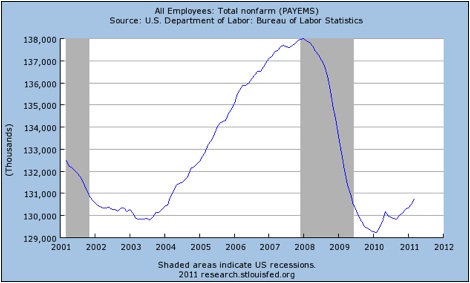
Let’s play pretend that jobs are really really coming back, so please ignore this chart, or turn it upside down:

Also ignore that Big U.S. Firms Are Shifting Hiring Abroad.

The rubbah slippah folks understand that something is not right. But here in Hawai‘i, there is a way out of this. Move to geothermal now! No fool around!

Supporting Kids’ Financial Literacy

I recently attended a reception for Richard Henderson, who had just been inducted into Junior Achievement of Hawaii’s “Business Hall of Fame.” It was a nice evening at the Naniloa Hotel in Hilo, and a nice tribute to him.

From the Hawai‘i Tribune-Herald:

Henderson was born in Hilo in 1928 and graduated from Punahou High School in 1946. Armed with a degree in business from Wharton School of Finance and Commerce, Henderson returned to Hilo in 1951. He joined The Realty Investment Co., which became his springboard for launching and managing a number of Big Island businesses, including nine theaters, an insurance agency, a wireless phone company, several car dealerships, Comtec Cable Co., KPUA and KWXX radio stations.

In addition, Henderson served for 15 years in the state Senate, often in leadership positions. Over the years he has also supported and served in key roles with many non-profit organizations on Hawaii Island.

It was also interesting to hear more about Junior Achievement (JA). What a terrific organization. I already knew that, but it was interesting to hear that, just here in Hilo and Puna last year, more than 100 of our local business people volunteered several hours each in 116 K-6 classrooms, and reached 2800 students. JA also meet with middle school and high school students.

Junior Achievement’s purpose is to “educate and inspire young people to value free enterprise so they can improve the quality of their lives and their communities.”

Its high school Company Program pairs business leaders with high school kids who create a business and learn how to write a business plan, research their market, efficiently manufacture their products, promote and sell their goods, keep the employees happy and keep the books straight.

Lee Wilson, president of JA on the Big Island, said, “This year, the six companies amassed revenues of nearly $50,000 in a shortened sales window of just over 8 weeks. What recession? I think Mr. Henderson would have been thrilled if a few of his startups had generated that type of volume right out of the gate.”

I think so.

Out Of Business


Tomatoes

Farming is a challenging business, and getting more challenging every day. That this tomato company in Southern California just halted operations is a good example of that.

Oceanside Pole Tomato Sales Inc., the marketing arm of Harry Singh & Sons, is one of the country’s largest tomato suppliers, packing and selling 4.5 to 5 million cartons of tomatoes a year. Harry Singh & Sons was one of nine companies that make up a Fresno-based cooperative that grows about 90 percent of the country’s fresh tomatoes.

It’s noteworthy that they had to shut down operations so suddenly. According to the article in The Packer, it was due to a “perfect storm of issues,” including labor and water costs, competition from Mexico, California’s regulatory climate and urban encroachment.

As I have often said, “If the farmer makes money, the farmer will farm.” As oil prices rise, I am curious to see if other mainland farmers are feeling economic pressures as well.

From The Packer:

Oceanside focuses on 2012 return with tomatoes

Published on 04/14/2011 06:40PM

Southern California’s Oceanside Pole Tomato Sales Inc., one of the nation’s largest suppliers to retail of vine ripe tomatoes, abruptly halted operations April 12, as did grower Harry Singh & Sons because of “a perfect storm of issues” related to costs.

Barbara Metz, a spokeswoman for Harry Singh & Sons, said April 14 that the company had not gone bankrupt. She said “a perfect storm of issues” including costs of labor and water, competition from Mexico, California’s regulatory climate and urban encroachment had caused the shutdown.

“I’ll be closing down the company in the next few weeks,” said Bill Wilber, Oceanside Pole president, on April 13.

Krishna Singh, general manager of the growing company and grandson of its founder, sent a message to that firm’s employees the same day, explaining that the company would not be operating for the 2011 season.

“I regret to inform you that effective immediately, Harry Singh and Sons Farming Partnership will not be in operation for the 2011 season. … We will work diligently and explore all options in our efforts to reorganize and resume farming operations for 2012,” according to the e-mail message.

The closures of Oceanside Pole and Singh’s growing operation could put a dent in the upcoming season’s vine-ripe category.

Read the rest

$100 To Fill Your Car With Gas?!

The Star-Advertiser just ran an article about peak oil, using gasoline prices as an example of some of the stark realities ahead of us.

The writer characters a switch to geothermal energy as a “a tough sell, but one that will become easier the first time it costs you $100 to fill up.”

Believers in ‘peak oil’ preparing for when a fill-up costs $100

By Richard Borreca 

POSTED: 01:30 a.m. HST, Apr 12, 2011

Standing in the state Capitol basement is a new symbol that times have changed: an electric vehicle charging station.

Hawaii may have only a few electric cars so far, but state law requires large public parking structures to have at least one charging station. As many as 320 of the 2-foot-tall systems are expected to be installed across the state.

It is part of the answer to the looming crisis of peak oil, which is defined as the time when global oil extraction reaches its maximum rate and the rate of extraction declines….

Read the rest

How much does it cost you these days to fill up your car? Leave a comment and let us know.